Rudraksh Tree (Elaeocarpus sphaericus): Can It Grow in Jaipur?
Elaeocarpus sphaericus
Rudraksh, the sacred bead tree, comes from the humid Himalayan foothills. It can grow in Jaipur only in a shaded, sheltered spot with drip water, summer shade net and winter frost cover, and beads are not guaranteed.
Bot User
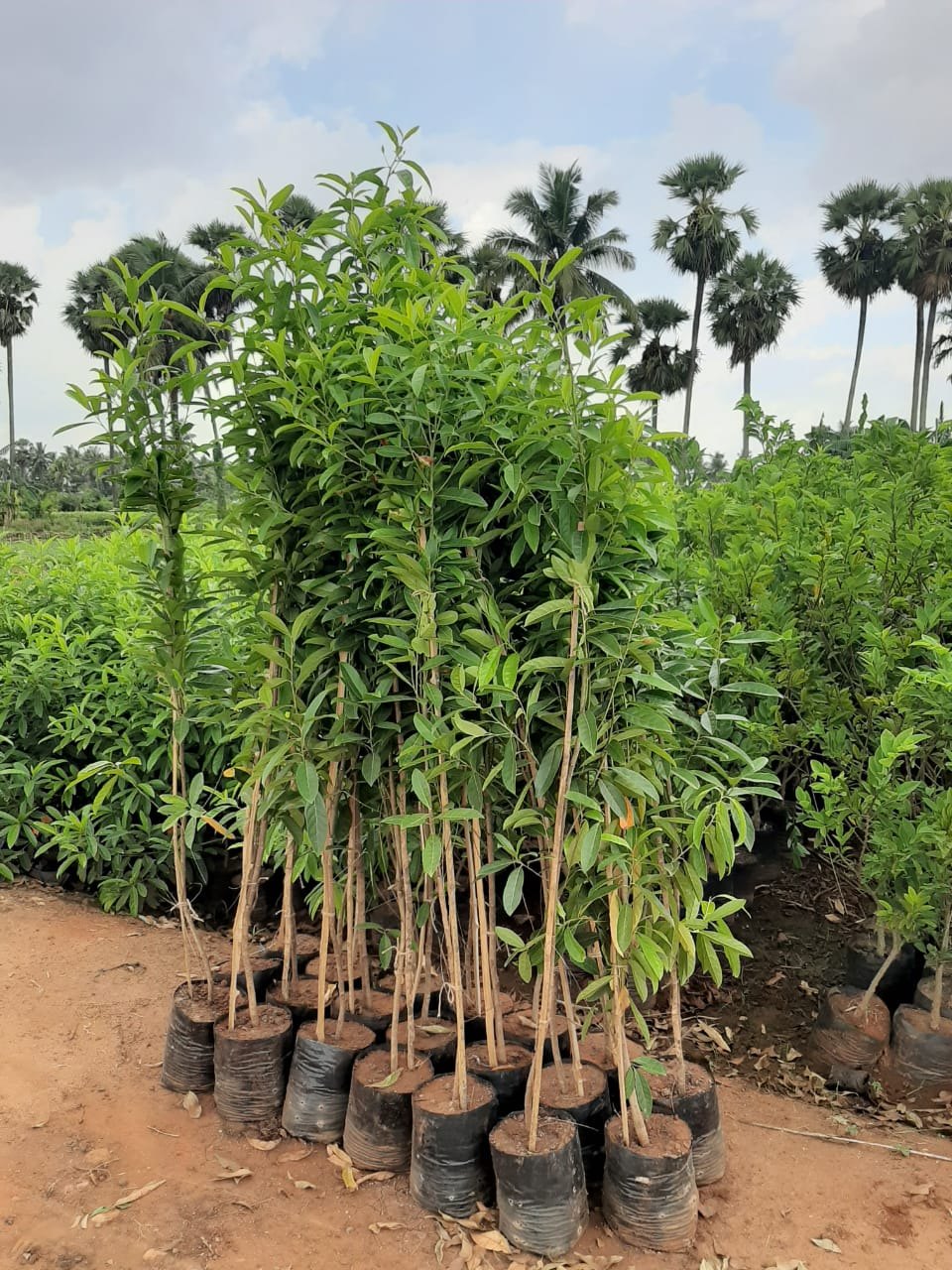
Rudraksh is the evergreen tree whose seeds become the sacred prayer beads worn across India. It is a tree of the humid, shaded Himalayan foothills and North-East India, so growing it in Jaipur is possible only with special care. This guide explains honestly what that care looks like.
Quick facts
| Scientific name | Elaeocarpus sphaericus (syn. Elaeocarpus ganitrus) |
| Family | Elaeocarpaceae |
| Hindi name | रुद्राक्ष (Rudraksh) |
| Other names | Rudraksha, Rudraksham, Rosary nut |
| Type | Evergreen, broad-leaved tree |
| Height | A large tree in its native forests; in central India, about 15 ft at around 4 years (Indore) and over 30 ft at about 8 years (Jabalpur) |
| Growth rate | Moderate in humid places; expect slow growth in Jaipur |
| Water need | High |
| Light | Partial shade |
| Best planting months in Jaipur | Mid-July to August (monsoon) |
| Jaipur suitability | Marginal in a shaded, sheltered, irrigated spot; poor in open ground |
Can it grow in Jaipur?
Only with special care. Rudraksh is native to the West and East Himalaya, Nepal, Assam, Bangladesh and Myanmar. A scientific review describes it as needing a humid to warm climate, preferably partial shade, and temperatures of about 10–30 °C. In the forests of Arunachal Pradesh it grows under taller trees.
Jaipur is the opposite. It gets roughly 600–650 mm of rain a year, very low humidity in April–June, summer highs above 45 °C with hot loo winds, and alkaline soil. Rudraksh prefers slightly acidic to neutral soil (pH about 6.0–7.3).
Shade is not optional. In a study published in Tropical Ecology, Rudraksh seedlings survived and grew better under dense tree cover than in open sites, and disease attack was highest in the open. The researchers recommended planting it under established trees or in slightly shaded spots.
Rudraksh has been grown in hotter, drier parts of central India, but with care and in places wetter than Jaipur. In Indore, a sapling planted in 2005 at a private home was about 15 ft tall and fruiting by 2009; the owner protected it with shade cloth in summer. In Jabalpur, two trees at the State Forest Research Institute grew to over 30 ft in about 8 years and fruit in alternate years. We found no documented, long-term planting that has survived and fruited in Rajasthan. Many nurseries sell Rudraksh plants in Jaipur, but a sale does not mean the tree will establish.
That is why GreenEye treats Rudraksh as a "special-care" tree here, plants it only in sheltered spots, and does not promise beads.
How to plant it
When: Mid-July to August is best. Humidity and soil moisture are at their highest, and the young plant gets about eight months to root before its first summer. Early September is a second choice, only with shade and irrigation. Avoid spring planting; a small plant set out in February–March faces May–June heat almost at once.
What to plant: A nursery sapling, not seed. Rudraksh seed stays viable for less than three months and germinates slowly and unevenly. A well-hardened sapling of 2–3 ft in a large bag is a good choice. Buy from a trusted source, such as a forest-department nursery, because look-alike Elaeocarpus species are often sold as Rudraksh.
Where: Choose a protected spot: beside or under existing tall trees that give afternoon shade (such as an established neem, peepal or arjun), on the north or east side of a wall or building, or near a pond or tank for extra humidity. Keep it 6–8 m from other trees, or place it 3–5 m from the east or north side of an established shade tree so it gets morning sun and afternoon shade. Avoid power lines and foundations.
The pit: Dig 60 × 60 × 60 cm, or up to 90 cm in poor, alkaline soil. Refill with 1 part compost or leaf mould, 1 part sand and 2 parts good topsoil, so the soil drains well and the alkalinity is softened. Add neem cake against termites. Plant at the same depth as in the nursery bag, make a basin, and spread 10 cm of organic mulch, kept away from the stem.
Care in the first 3 years
These are practical recommendations for Jaipur, based on standard horticultural practice:
- Monsoon (July–September): Plant in year 1 and remove the shade net once the rains settle. Water every 3–5 days (about 10–15 litres) if it does not rain. Make sure no water stands around the roots. Weed, and add compost from year 2.
- Post-monsoon (October–November): Keep 10 cm of mulch. Water every 4–5 days in year 1, every 5–7 days in year 2, and about weekly in year 3. Watch for leaf-eating caterpillars.
- Winter (December–February): Cover young plants with a jute or thatch hood on cold nights for the first 2–3 winters. Water less, since cold, wet roots are harmful.
- Spring (March–April): Put up a 35–50% green shade net by early March, and a windbreak on the west and south-west side against the loo. Water every 2 days (about 15–20 litres).
- Summer (May–June): The most critical time. Give daily drip irrigation in the morning (about 15–20 litres). On the hottest days (44 °C and above), wet the surrounding ground or mist in the evening to raise humidity. Keep the mulch thick and check for leaf scorch. Never let the root zone dry out, but make sure it drains.
Prune only dead or damaged shoots, and keep a single main stem. Inspect the plant every month for pests. Where possible, use harvested rainwater rather than very hard or salty water.
Benefits
Cultural
Rudraksh seeds are central to Hindu, especially Shaiva, devotional practice.
Shade
It is an evergreen, broad-leaved tree that gives year-round shade where it grows well. In Jaipur, this benefit is modest and slow to arrive.
Traditional use
The beads and plant parts are traditionally used in Ayurveda and folk medicine for stress, anxiety, palpitation, high blood pressure and other conditions. This is traditional use, not a proven treatment; the beads are a religious object, not a medicine.
Ornamental
It has attractive, glossy, lance-shaped leaves, and ripe fruits turn blue.
Helping wild trees
In the wild, Rudraksh is under pressure from bead harvesting. A study in Arunachal Pradesh found no young trees coming up in heavily disturbed forest stands. Growing it in cultivation can reduce pressure on wild trees.
Cultural significance
Rudraksha beads, the cleaned stones of the fruit, are widely used as prayer beads (japa mala) in Hinduism, particularly by devotees of Shiva. The name is traditionally read as Rudra (Shiva) + aksha (eye or tears). Beads are classified by the number of natural faces (mukhi), and texts such as the Rudrakshajabala Upanishad discuss them.
Scientists at the State Forest Research Institute, Jabalpur, have noted that, botanically, fruits from different regions are essentially the same, so high prices based only on where a bead comes from are not scientifically justified.
Cautions and safety
- Climate mismatch: This is the main caution. In open ground in Jaipur the risk of losing the plant is high. It needs shade net, drip irrigation, mulch, a windbreak and frost cover.
- No bead guarantee: Rudraksh usually takes years to fruit even in good conditions, and fruiting in Rajasthan is uncertain.
- Look-alikes: Saplings and beads are often mislabelled. Buy from a trusted nursery and keep a record of the source.
- Water use: Its high water need conflicts with Jaipur's groundwater stress, which is a reason to plant only a few.
- Toxicity: No reliable toxicity data were found for people or animals. The fruits and seeds are not a recognised food, so do not eat them.
- Space: It can become a large tree in good conditions.
- Status: Rudraksh has not been assessed on the IUCN Red List. It is not invasive.
Plant a Rudraksh in someone's name with GreenEye: Gift a Tree
Planting calendar
- Northwest arid · Monsoon · Jul, Aug
Planting methods
SaplingPrimary method
Grafting
Seed
Benefits
- Cultural: Its seeds (beads) are central to Hindu, especially Shaiva, devotional practice and are used as prayer beads (japa mala).
- Shade and cooling: An evergreen broad-leaved tree giving year-round shade where it grows well; in Jaipur this benefit is modest and slow.
- Medicinal: Beads and plant parts are traditionally used in Ayurveda and folk medicine for stress, anxiety, palpitation and high blood pressure. Traditional use only, not a proven treatment.
- Ornamental: Attractive glossy, lance-shaped foliage; ripe fruits turn blue.
- Other: Wild Rudraksh is under harvest pressure for beads and regenerates poorly in disturbed forests; growing it in cultivation can reduce pressure on wild trees.
Frequently asked questions
Can Rudraksh grow in Jaipur?
Only with special care. It comes from humid Himalayan foothills, so we plant it in shaded, sheltered spots with drip water and summer shade nets.
Will my tree give Rudraksha beads?
We can't promise it. Rudraksh usually takes 5–8 years to fruit even in good conditions, and fruiting in Rajasthan's climate is uncertain.
What happens if it doesn't survive?
We monitor every gift tree. If a sapling dies, we replant it, either with another Rudraksh or, with your consent, a sacred tree suited to the local climate.
Why is it called Rudraksh?
The name links Rudra (Lord Shiva) with aksha (eye or tears). Its seeds are used as prayer beads.
Is it a native tree of India?
Yes. It is native to the Himalayan foothills and North-East India, but not to Rajasthan's dry climate.
Sources
- Kew, World Checklist of Vascular Plants (WCVP) via GBIF
- Kew POWO page for Elaeocarpus ganitrus (to confirm by hand)
- IUCN Red List category via GBIF: Elaeocarpus sphaericus (Not Evaluated)
- Pant M, Lal A, Bisht P, Rani A (2013). Elaeocarpus sphaericus: A Tree with Curative Powers: an Overview. Research Journal of Medicinal Plant 7:23-31
- Khan ML, Bhuyan P, Tripathi RS (2004). Survival and growth of seedlings of Rudraksh under varied canopy conditions after transplant. Tropical Ecology 45:233-239
- Bhuyan P, Khan ML, Tripathi RS. Regeneration status and population structure of Rudraksh in tropical wet evergreen forest of Arunachal Pradesh
- Webdunia Hindi: Rudraksh tree laden with fruit (Indore, 2009)
- ETV Bharat Hindi: Rudraksh trees at the State Forest Research Institute, Jabalpur (21 Feb 2023)
- iNaturalist observations of Elaeocarpus ganitrus (taxon 430972)
- Nurserylive: Rudraksha tree care guide (nursery source)
- In vitro propagation of Rudraksha (Elaeocarpus sphaericus): a biotechnological approach for conservation (PMC)
- Wikipedia: Rudraksha
- Wikipedia: Rudrakshajabala Upanishad
- Flowers of India: Elaeocarpus tuberculatus (Warty Marble Tree)
This article was prepared with AI assistance. Please verify important details with the sources listed.
Plant a tree you can track
Plant a tree on GreenEye land and track it as it grows.
Share this article