Khejri Tree (Prosopis cineraria): Rajasthan's State Tree and How to Grow It in Jaipur
Prosopis cineraria
Khejri is Rajasthan's state tree: it stays green in the hottest months, enriches the soil and gives sangri and fodder. How to plant it in Jaipur, care for it in the first three years, and why it matters to the Bishnoi community.
Bot User
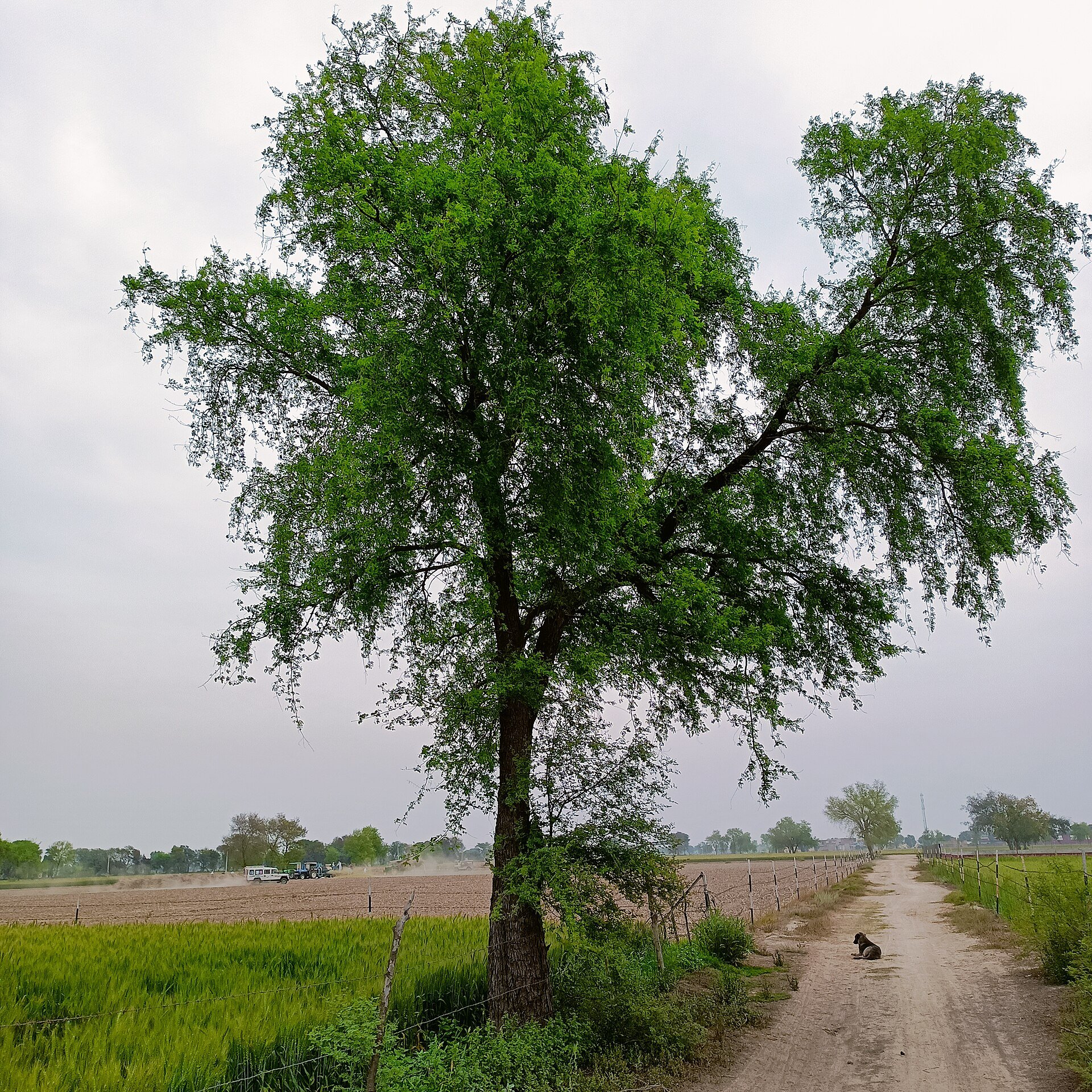
Khejri (Prosopis cineraria) is Rajasthan's state tree and one of the few trees that stays green through the desert's hottest months. Its deep roots reach underground moisture, it enriches the soil, and its leaves and pods feed animals and families.
Photo: "A tree of Prosopis Cineraria in India" by Mulkh Singh, CC BY-SA 4.0, via Wikimedia Commons
Quick facts
| Scientific name | Prosopis cineraria (L.) Druce |
| Family | Fabaceae (legume family) |
| Hindi name | खेजड़ी (Khejri), also Jand and Shami |
| Height | Usually 5–10 m; some trees reach 10–12 m |
| Growth rate | Slow above ground in the early years |
| Water need | Low once established; regular watering in the first dry seasons |
| Best planting months in Jaipur | July–August (monsoon); September–October is second-best |
| Jaipur suitability | Excellent |
Why plant Khejri in Jaipur
Khejri is native to the arid and semi-arid north-west of India. ICAR-CIAH (Bikaner) describes it as tolerating extreme heat of up to about 50 °C, hot loo winds, frost and severe drought, and it grows with as little as 75–450 mm of rain a year. Jaipur, with roughly 600–650 mm, sits well inside its comfort range. A CIAH survey has also recorded Khejri in Jaipur district.
Khejri puts out new leaves, flowers and pods in the driest months, March to June. It tolerates alkaline soils (reported up to pH 9.8) but needs good drainage, and does poorly on shallow soil over a hard layer or on strongly saline soil. Dense shade kills its seedlings, so plant it only in full sun.
How to plant it
When to plant
The best time is July to August, when monsoon rains help the young plant build a strong taproot. September to October also works with nursery seedlings, with watering through the first dry season. Avoid April to June.
Choosing a sapling
A nursery sapling is the most reliable choice; Khejri does not grow well from cuttings. As practical advice, pick a plant 7–12 months old and 30–60 cm tall, grown in a deep bag so the taproot is not coiled. Grafted plants of selected varieties such as 'Thar Shobha' (ICAR-CIAH) are an option if you want sangri sooner.
Pit, spacing and protection
As practical advice, dig a pit 45–60 cm on each side, refill with the dug soil mixed with well-rotted farmyard manure, and add neem cake where termites are common. Plant at the same depth as in the nursery bag. In a grove, space trees 5–8 m apart so each grows a full crown.
A tree guard is essential for at least two to three years, because goats and camels badly damage young plants.
First-year watering (practical advice)
- July–September: water only if there has been no rain for 10 days or more, about 10 L.
- October–February: every 10–15 days, 10–15 L.
- March–April: every week, about 15 L.
- May–June: every 4–5 days, 15–20 L, early morning or evening.
Care in the first three years
Monsoon (July–September). Make a saucer-shaped basin. Because early growth is slow, weed two to three times in the first year; later, light weeding is enough.
Post-monsoon (October–November). Spread 5–8 cm of dry grass or leaf mulch. Water every 10–15 days in year one, every 2–3 weeks in year two, and only in long dry spells in year three.
Winter (December–February). Frost is rarely a problem. Watch for termites. From year two, light training pruning helps form a straight stem.
Spring (March–April). Water weekly in year one and every 10–14 days in year two. By year three it is mostly rain-fed.
Summer (May–June). The most critical time: water every 4–5 days in year one and every 7–10 days in year two. In year three, water only in a severe dry spell.
Pests. Browsing animals are the biggest risk. Also watch for stem and root borers, mealybugs and the parasitic climber dodder (Cuscuta), which you can pull off by hand. Do not lop the tree for fodder in its first three years.
Be patient
Khejri sends its roots deep first. Seedlings may reach only 1–2 m in four years, and protected plants take shape in about 4–5 years.
Benefits
Soil. Khejri is a nitrogen-fixing legume that raises soil organic matter, nitrogen, phosphorus and calcium under its canopy.
Food and fodder. Tender pods (sangri) are a well-known Rajasthani vegetable and a main ingredient of panchkuta, and ripe dry pods (khokha) are also eaten. The leaves (loong) are nutritious fodder that animals like, especially in winter when little other green fodder is available. Seed-grown trees usually take 10–15 years to bear pods regularly; grafted plants can start in 3–4 years.
Water and farming. Its deep taproot draws on deep soil moisture, so it does not compete for water with nearby crops.
Shade and wildlife. It gives light, filtered shade and stays green in summer, sheltering people, livestock and wildlife. Its spring flowers are valued for honey.
Land and wood. Khejri is planted to stabilise sand dunes. Its hard, heavy heartwood is used for posts, construction and fuelwood.
Traditional use. Its bark, leaves and flowers are traditionally used in Ayurveda and folk medicine. This is traditional use only, not medical advice.
Cultural significance
Khejri is Rajasthan's state tree, and India Post issued a stamp on it in 1988. As Shami, it has spiritual importance in Hindu tradition: the Ramayana and Mahabharata describe Shami-puja, and its wood was used to kindle the sacred fire for yajna. In parts of Rajasthan, green Khejri twigs are worshipped on Janmashtami.
The Bishnoi community follows Guru Jambheshwar's teaching to protect green trees and wildlife. In 1730, at Khejarli village near Jodhpur, Amrita Devi Bishnoi and her three daughters gave their lives trying to stop Khejri trees from being cut for the Jodhpur ruler's construction work. Many more Bishnois followed; the number commonly reported is 363. The Rajasthan government notes that this sacrifice later inspired the Chipko Movement of the 1970s.
Cautions and safety
- Thorns. The branches carry prickles. Plant away from paths and play areas, and wear gloves when handling.
- Not vilayati babool. Do not confuse Khejri with Prosopis juliflora (vilayati babool), a foreign species that has invaded grazing lands and sacred groves in the Thar. Make sure your nursery supplies true Prosopis cineraria.
- Toxicity. The pods traditionally eaten are not considered toxic, and leaves and pods are staple fodder for goats, camels, cattle and sheep. Folk belief holds that the fruit is hard to digest if eaten in excess. Effects on cats and dogs are not documented.
- Root suckers. In wetter areas it can spread by root suckers; this is not a big risk in Jaipur.
- Choose a permanent spot. Felling Khejri is restricted in Rajasthan. In February 2026 the state ordered a statewide ban on cutting Khejri, and in August 2026 the State Cabinet approved a tree protection bill that includes it. Plant it where it can stay for good.
Plant a Khejri in someone's name with GreenEye: Gift a Tree
Planting calendar
- Northwest arid · Monsoon · Jul, Aug
- Northwest arid · Post-monsoon · Sep, Oct
Planting methods
SaplingPrimary method
Seed
Grafting
Benefits
- Soil health: A nitrogen-fixing legume that raises soil organic matter, nitrogen, phosphorus and calcium under its canopy.
- Fodder: Its leaves (loong) are a palatable, nutritious fodder, especially valuable in winter when little other green fodder is available.
- Edible: Tender pods (sangri) are a well-known Rajasthani vegetable and part of panchkuta; ripe dry pods (khokha) are also eaten.
- Water conservation: Its deep taproot draws on deep soil moisture, so it does not compete for water with nearby crops.
- Shade and cooling: Gives light, filtered shade and stays green in summer, sheltering people, livestock and wildlife.
- Pollinators: Its abundant spring flowers (March–May) are valued for honey production.
- Biodiversity: A keystone tree of the Thar that supports wildlife through the summer.
- Timber: Hard, heavy heartwood used for posts, construction and tool handles, and as fuelwood.
- Medicinal: Bark, leaves and flowers are traditionally used in Ayurveda and folk medicine. Traditional use only, not medical advice.
- Cultural: Rajasthan's state tree, revered as Shami, and central to the Bishnoi tradition and the 1730 Khejarli sacrifice.
- Other: Planted to stabilise sand dunes and reclaim land.
Frequently asked questions
Will my Khejri survive Jaipur's summer?
Yes. It is one of the most heat- and drought-tolerant trees in India. We water it through its first two dry seasons and protect it with a guard.
Why is my tree growing so slowly?
Khejri first sends its roots deep underground, so it grows slowly above ground for the first few years. This is normal.
When will it give sangri?
Seed-grown trees usually take 10–15 years. Grafted varieties can start in 3–4 years.
Is Khejri the same as the thorny "vilayati babool"?
No. Khejri is a native tree; vilayati babool (Prosopis juliflora) is a foreign invasive shrub. We plant only true Khejri.
Why is Khejri special in Rajasthan?
It is the state tree, feeds people and livestock in drought, and is honoured by the Bishnoi community, whose members gave their lives to protect it at Khejarli in 1730.
Sources
- Kew, World Checklist of Vascular Plants: Prosopis cineraria (via GBIF)
- ICRAF Agroforestree Database: Prosopis cineraria species profile
- Flowers of India: Khejri Tree
- ICRAF Agroforestree Database PDF: Prosopis cineraria
- Samadia D.K., Haldhar S.M. et al. (2021). Khejri (Prosopis cineraria) research for horticultural harnessing and environmental services: an appraisal. Journal of Agriculture and Ecology 12:1–26, ICAR-CIAH Bikaner
- Government of Rajasthan (Rajasthan Foundation): Khejri, State Tree of Rajasthan
- Drishti IAS: Felling of Khejri Trees
- Wikipedia: Khejarli massacre
- Drishti IAS: Eradication of Vilayati Babool
- Free Press Journal: Rajasthan Bans Khejri Tree Felling After 11-Day Protest (13 Feb 2026)
- Drishti IAS: Rajasthan Imposes Statewide Ban on Felling of Khejri Tree
- Social News XYZ (IANS): Rajasthan cabinet clears draft bills on tree protection and UCC (13 Aug 2026)
This article was prepared with AI assistance. Please verify important details with the sources listed.
Plant a tree you can track
Plant a tree on GreenEye land and track it as it grows.
Share this article