Kachnar Tree (Bauhinia variegata): Where It Grows in India and How to Use Its Buds
Bauhinia variegata
Also known as कचनार, Kachnaar, Kachnal, or Orchid tree
Kachnar (Bauhinia variegata), called the orchid tree in English, flowers on bare branches in late winter and gives the buds for kachnar ki kali ki sabzi. Where it grows in India, its flowering season, how it copes with heat, dry summers and frost, when and how to plant it in each region, care for the first three years, and how to tell it from look-alike Bauhinia trees.
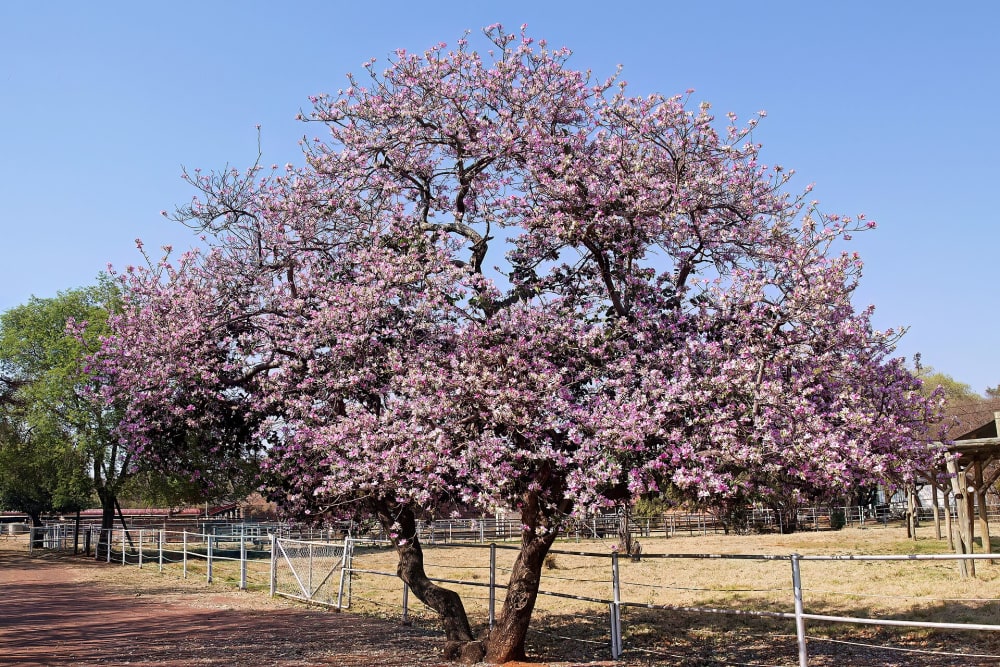
Kachnar (Hindi कचनार, also spelt kachnaar; Bauhinia variegata), called the orchid tree in English, is the flowering tree that lights up north Indian streets at the end of winter. In many north Indian places, for a few weeks around February and March (the timing varies by region), it stands almost bare, covered in large pink, mauve or white flowers that look like orchids, and its tight green buds go from the branch straight into the kitchen as kachnar ki kali. It is a small to medium tree that fits a school ground or colony park.
Photo: "Bauhinia variegata var. variegata 50D 7055" by SAplants, CC BY-SA 4.0, via Wikimedia Commons
20 min read
Contents
At a glance
How much care, water and sun this tree needs, and how fast it grows.
View as table
| Measure | Level |
|---|---|
| Care level | Moderate (2/3) |
| Water | Moderate (2/4) |
| Sunlight | Full sun (4/4) |
| Growth rate | Moderate (2/3) |
Best time to plant
- Planting month
- Planting month, grows with care
Months to plant this tree in each region of India where it grows.
View as table
| Region | Suitability | Planting months | Season |
|---|---|---|---|
| Northwest arid | Grows with care | July and August | Monsoon |
| North plains (Indo-Gangetic) | Suitable | July and August | Monsoon |
| Central India | Suitable | July and August | Monsoon |
| East India | Suitable | June, July and August | Monsoon |
| Northeast India | Suitable | May, June and July | Monsoon |
| West coast | Grows with care | June and July | Monsoon |
| East coast | Suitable | July and August | Monsoon |
| East coast | Suitable | October and November | Post-monsoon |
| South peninsula | Suitable | June, July and August | Monsoon |
| Himalayan region | Suitable | July and August | Monsoon |
- Mature size
- Up to about 15 m tall (ICFRE, ICRAF), much smaller in dry forests (ICRAF); spreading crown about 3-6 m wide (Flowers of India)
- Soil type
- Well-drained sandy loam is best; tolerates gravelly, shallow and rocky soils; avoid waterlogged low spots
- Family
- Fabaceae
- Native region
- Indian Subcontinent to southern Yunnan, China (Kew POWO): India (including Assam and the West and East Himalaya), Pakistan, Nepal, Bangladesh, Myanmar, Thailand, Laos and Vietnam; planted and introduced in many other warm countries, including Sri Lanka
- Climate zones
- Subtropical, Tropical dry and Semi-arid
- Conservation status
- Least concern (LC)
Quick facts
| Scientific name | Bauhinia variegata L. (some botanists use Phanera variegata) |
| Family | Fabaceae (legume family; older books list it under Caesalpiniaceae) |
| Hindi name | कचनार (Kachnar, also spelt Kachnaar), also कचनाल (Kachnal) |
| English names | Orchid tree, mountain ebony, camel's foot tree |
| Other names | Kovidara and Kanchanara (Sanskrit); Kanchan (Assamese, Marathi), Raktakanchan (Bengali), Koiralo (Nepali) (Flowers of India) |
| Mature height | Up to about 15 m (ICFRE, ICRAF); ICRAF notes it is much smaller in dry forests |
| Crown | Spreading; Flowers of India gives about 10–20 ft (3–6 m) wide |
| Flowering | Mostly February–April in north India, often on bare branches; it can start in late January, and timing varies by region |
| Water need | Moderate; ICRAF calls an established tree fairly drought-resistant, but young trees need water in dry spells for the first 2–3 years |
| Planting season | With the first good rains in most regions (ICFRE); months are a guide, see Planting calendar |
| Grows well in | The low and mid Himalayan hills (ICFRE: up to about 1,800 m) and the plains of north, east and central India; with care in the north-west dry zone and on the wettest west coast |
| Conservation status | Least Concern (IUCN Red List global assessment, 2012) |
Where kachnar grows in India
Kachnar is not a desert tree like khejri or neem. ICFRE describes it as a tree of the plains of north, east and central India and of the low and mid hills of the Himalaya, up to about 1,800 m. ICRAF gives the same upper limit, but treat it as an approximate record: elevation limits vary with the source and the locality. Kew's Plants of the World Online gives its native range as the Indian Subcontinent to southern Yunnan in China, including India, Assam, the West and East Himalaya, Pakistan, Nepal, Bangladesh, Myanmar, Thailand, Laos and Vietnam. Native range is not the same as where it is planted: it is grown as an ornamental in many warm countries, and Kew lists Sri Lanka among the places where it was introduced. ICFRE describes it as a tree of hot, dry summers and mild winters, with 500 to 2,500 mm of rain a year, and notes that it usually avoids arid tracts that get less than 500 mm.
- Grows well: the Himalayan foothills and mid hills, the northern plains, central India, the east, the north-east, the east coast and the southern peninsula (India Flora Online, from the IISc herbarium, has records from districts of Odisha, Andhra Pradesh, Tamil Nadu and Kerala).
- With care: the north-west dry zone, where young trees need water through their first two or three summers; and the wettest parts of the west coast, which get more than 2,500 mm of rain, so plant on raised, well-drained, sunny ground.
Once its roots are down, both ICFRE and ICRAF call it fairly drought-hardy. Cold is less of a worry. ICFRE lists kachnar as frost-hardy; ICRAF adds that severe frost kills the leaves of seedlings and saplings, which recover during summer. In frost-prone areas, a light cover on the worst nights of the first winter is a sensible precaution (practical guidance).
It grows best in well-drained sandy loam and copes with gravelly, rocky ground. Avoid low spots where rainwater stands. Kachnar is already a familiar garden and roadside tree in north Indian cities, and eFlora of India has records of it from Delhi.
How to recognise kachnar
The surest sign is the leaf, which is split at the tip into two rounded lobes; Flowers of India says it looks a little like a cow's hoof. Flora of China describes the leaf blade as roughly 5–9 cm long and 7–11 cm wide, nearly round to broadly ovate, with a heart-shaped base and the tip split to about a third of its length.
- Flowers: large and orchid-like, in pink, mauve, purple or white, with petals roughly 4–5 cm long (Flora of China); often on bare branches in late winter, mostly February–April in north India.
- Buds: smooth, green and spindle-shaped (Flora of China); these are the buds cooked as kachnar ki kali.
- Pods: long and flat with woody walls, roughly 15–25 cm long (Flora of China).
- Bark: dark brownish and nearly smooth (Flora of China).
- Shape: a small to medium deciduous tree with a spreading crown, roughly 3–6 m wide (Flowers of India).
- Look-alike: Bauhinia purpurea, sometimes also called kachnar, has only three fertile stamens instead of five and, in Delhi, flowers in September–October with its leaves on (Flora of China, eFlora of India; see Choosing a sapling). These are identification clues, not a food-safety test.
How to plant kachnar
When to plant
ICFRE says nursery-raised seedlings are planted out in the first rains. So plant once reliable local rain has properly wetted the soil and the site drains well. As a guide: July or August in the north-west dry zone, the northern plains, central India, the Himalayan foothills and on the Odisha and Andhra coast; June to August in the east and the southern peninsula; May to July in the north-east; and June to July on the west coast. October to November applies only where the main rains come with the north-east monsoon, as on the Tamil Nadu coast. These months are our guide, not a rule from a source: the best month varies by district and monsoon pattern. In dry areas, plant only where you can water the young plant through its first dry seasons, and avoid planting in the hot, dry months of April to June.
Choosing a sapling
Buy a polybag sapling from the forest department or a nursery you trust. A sapling of about 1–1.5 m is our rule of thumb, because a taller plant gets above goats and trampling feet sooner; ICFRE notes that nursery seedlings only 2–3 months old are also planted out in the first rains. ICFRE says kachnar is raised from seed; vegetative propagation is not used for regular planting.
Check that you are getting the right tree. Several Bauhinia species may be sold as, or called, kachnar. The features below help, but they are clues, not a test of whether a plant is safe to eat. Flora of China describes Bauhinia variegata with five fertile stamens, and the similar Bauhinia purpurea with only three fertile stamens (plus 5–6 small sterile ones); eFlora of India adds that B. purpurea has more slender petals. eFlora of India also notes that in Delhi kachnar flowers about February–March, mostly before the new leaves, while B. purpurea flowers in September–October with its leaves on. Flowering times shift by region. If you are unsure, ask a botanist or a qualified horticulture professional before harvesting buds for food.
Pit, spacing and protection
- Pit: prepare a hole suited to the root ball and your soil; about 60 cm each way is our rule of thumb for a polybag sapling. Refill with the dug soil mixed with well-rotted farmyard manure, and plant at the depth the sapling stood in its bag, without burying the stem or root collar.
- Spacing: this depends on the purpose. About 5–6 m between trees in a garden row or avenue is our rule of thumb (Flowers of India gives a crown about 3–6 m wide). It is a planting layout, not a safe distance from buildings: near walls, drains, foundations, underground pipes or overhead wires, think about the size of a mature tree and the site, and ask a local horticulture or forestry office if space is tight.
- Basin: shape a saucer-like basin (about 1 m across is our rule of thumb) to hold rainwater, but do not let water stand around the stem.
- Guard: ICRAF notes that sheep, goats and cattle eat the leaves greedily, so put up a sturdy tree guard where livestock or trampling are likely, for at least the first two years (practical guidance).
First-year watering (practical advice)
Water according to the soil and weather, not the calendar alone. None of our sources gives a watering schedule for kachnar, so the intervals below are our rough starting point for a newly planted sapling in a hot, dry area, not trial results. Before watering, check the soil a few centimetres down near the roots: water deeply when the root zone is drying, skip watering after rain, and never let water stand around the stem. Sandy soil dries faster than heavier soil. The amount and interval depend on sapling size, soil, heat and local rainfall.
- Monsoon (Jul–Sep): usually only after a long dry break.
- Post-monsoon and winter (Oct–Feb): about every 1–2 weeks if the soil is dry.
- Spring (Mar): about weekly if the soil is dry.
- Summer (Apr–Jun): about every 3–4 days in hot, dry places, less if the soil is still moist.
Planting methods
SaplingPrimary method
Dig a pit
Mix compost into the dug-out soil
Set the plant at its nursery soil level
Firm the soil and shape a watering basin
Water it well
Seed
Pick fresh, healthy seed and prepare it
Sow at a shallow, even depth
Depth ≈ 1 cmCover lightly and keep the soil moist
Transplant the seedling once it is sturdy
Planting calendar
- Northwest arid Grows with care · Monsoon · Jul, Aug
ICFRE: nursery seedlings are planted out in the first rains, and kachnar usually avoids arid tracts with less than 500 mm of rain. In the dry zone, plant only where you can water the young plant reliably through its first hot seasons; rain alone may not be enough. Months are a guide: plant once the local rains have wetted the soil (moist, not waterlogged), and check your district's advice.
- North plains (Indo-Gangetic) · Monsoon · Jul, Aug
ICFRE nursery manual: kachnar grows in the plains of north, east and central India, in 500-2500 mm rainfall. Months are a guide: plant once the local rains have wetted the soil (moist, not waterlogged), and check your district's advice.
- Central India · Monsoon · Jul, Aug
ICFRE nursery manual: native to the plains of central India; frost- and drought-hardy, best in well-drained sandy loam. Months are a guide: plant once the local rains have wetted the soil (moist, not waterlogged), and check your district's advice.
- East India · Monsoon · Jun, Jul, Aug
ICFRE nursery manual: native to the plains of east India. ICRAF says it needs good drainage, so avoid waterlogged pits. Months are a guide: plant once the local rains have wetted the soil (moist, not waterlogged), and check your district's advice.
- Northeast India · Monsoon · May, Jun, Jul
Kew POWO lists Assam and the East Himalaya in its native range, and Flowers of India shows it photographed in Imphal. Plant on well-drained ground (ICRAF). Months are a guide: plant once the local rains have wetted the soil (moist, not waterlogged), and check your district's advice.
- West coast Grows with care · Monsoon · Jun, Jul
ICRAF gives a rainfall range of 500-2500 mm and says it needs good drainage; the wettest parts of this coast get more rain than that, so plant on raised, well-drained, sunny ground. Months are a guide: plant once the local rains have wetted the soil (moist, not waterlogged), and check your district's advice.
- East coast · Monsoon · Jul, Aug
ICRAF: a tree of tropical and subtropical climates with hot, dry summers, in 500-2500 mm rainfall. July-August suits places that get their main rain from the south-west monsoon, such as coastal Odisha and Andhra. Months are a guide: plant once the local rains have wetted the soil (moist, not waterlogged), and check your district's advice.
- East coast · Post-monsoon · Oct, Nov
October-November applies only where the main rains come with the north-east monsoon, as on the Tamil Nadu coast; plant there once those rains have wetted the soil. (TNAU Agritech gives a nursery method for it under its Tamil name Segappumantharai, but no field-planting months.) Months are a guide: plant once the local rains have wetted the soil (moist, not waterlogged), and check your district's advice.
- South peninsula · Monsoon · Jun, Jul, Aug
ICRAF: suits tropical climates with hot, dry summers and 500-2500 mm rainfall; TNAU Agritech publishes a nursery method for it (not planting months). Months are a guide: plant once the local rains have wetted the soil (moist, not waterlogged), and check your district's advice.
- Himalayan region · Monsoon · Jul, Aug
ICFRE nursery manual: grows in the low and mid hills of the Himalaya up to about 1800 m (an approximate limit that varies by locality). ICRAF: severe frost kills the leaves of seedlings and saplings, but they recover during summer, so a light cover on the coldest nights of the first winter is a sensible precaution. Months are a guide: plant once the local rains have wetted the soil (moist, not waterlogged), and check your district's advice.
Soil pH
Check your soil pH
No verified pH range for this tree yet. Test your soil and ask your nearest KVK before adding anything.
Before planting
- Ask your nearest Krishi Vigyan Kendra (KVK) to test the soil and advise.About 8 weeks before planting
At planting
- Mix well-rotted farmyard manure or compost into the pit soil.At planting
After the monsoon
- Test the pH again after the first monsoon, then once a year.After the first monsoon
When this tree is planted
- Northwest arid · Jul, Aug
- North plains (Indo-Gangetic) · Jul, Aug
- Central India · Jul, Aug
- East India · Jun, Jul, Aug
- Northeast India · May, Jun, Jul
- West coast · Jun, Jul
- East coast · Jul, Aug
- East coast · Oct, Nov
- South peninsula · Jun, Jul, Aug
- Himalayan region · Jul, Aug
Guidance only. Test your soil (Soil Health Card or your KVK lab) before adding anything.
Based on
- Aonla cultivation (Unit 2) – IGNOU eGyanKosh
Care in the first three years
Monsoon (Jul–Sep): in year 1, plant, shape the basin and fix the guard. Weed the basin two or three times during the rains in years 1 and 2.
Post-monsoon (Oct–Nov): lay dry leaves or straw as mulch (about 8–10 cm is our rule of thumb), kept off the stem.
Winter (Dec–Feb): the tree is deciduous. ICRAF gives leaf fall in November–December in India, while CSIR-NEERI notes that in Nagpur the leaves start falling in January and the trees are bare by March; the timing varies with climate. This is normal. In frost-prone areas, in the first winter cover the sapling with jute or a straw hood on nights when IMD warns of frost or a cold wave (practical guidance).
Spring (Feb–Apr): ICRAF notes that a young tree may start flowering at 2–3 years. Watch for psyllids (Psylla simlae), tiny sap-sucking insects; ICRAF says leaves and flowers infested by the nymphs shrivel and fall. Ask your local Krishi Vigyan Kendra or forest department about currently approved control.
Summer (Apr–Jun): the hardest season in hot, dry regions. As a rough starting point, water about every 3–4 days in year 1, about weekly in year 2, and in year 3 only during long hot spells, but check the soil first and water less if it is still moist. Keep the mulch topped up.
Pruning: in year 2 or 3, remove low, crossing or damaged branches to get a clean trunk (practical guidance). ICRAF notes that kachnar coppices well and stands heavy lopping fairly well, so it forgives mistakes.
Fire: clear dry grass from around the trunk; ICFRE and ICRAF describe the tree as susceptible to fire.
Varieties
Known varieties and forms of this tree in India, how they differ and where they grow.
Botanical variety (2)
Purple-pink kachnar (Bauhinia variegata var. variegata)Flower colour: Pink to reddish purple, upper petal darker
The usual kachnar, whose flowers are most often a lively reddish purple. Kew's WCVP checklist accepts it as the typical variety of the species.
- Flower colour
- Pink to reddish purple, upper petal darker
Sources: Royal Botanic Gardens, Kew, GBIF / Royal Botanic Gardens, Kew (WCVP), eFlora of India, Flowers of India
White-flowered kachnar (Bauhinia variegata var. candida)Flower colour: Pure whiteGrown in: West coast, South peninsula
Kew (POWO / WCVP) accepts Bauhinia variegata var. candida as a botanical variety with white flowers; eFlora of India records it from Shirgaon near Chiplun (Maharashtra) and Tumkur (Karnataka). Some botanists there treat white trees as only a colour form or cultivar 'Candida'. A nursery's flower-colour label alone does not verify botanical identity.
- Flower colour
- Pure white
- Other
- Hindi names: safed kachnar, karbudar
Sources: Royal Botanic Gardens, Kew, GBIF / Royal Botanic Gardens, Kew (WCVP), eFlora of India, Flowers of India
Compare all varieties
| Variety | Flower colour | Other |
|---|---|---|
| Purple-pink kachnar (Bauhinia variegata var. variegata) | Pink to reddish purple, upper petal darker | — |
| White-flowered kachnar (Bauhinia variegata var. candida) | Pure white | Hindi names: safed kachnar, karbudar |
Where to get seeds and saplings
Real nurseries and institutes we checked. Stock changes, so confirm before you travel.
- Dilli Free Tree (Delhi Forest Department nurseries)
Serves: North plains (Indo-Gangetic)
Delhi, Delhi
Free seedlings: apply on the portal, then collect from a Delhi forest nursery. When we checked on 20 October 2026, the species-wise stock page listed Kachnar (Bauhinia variegata) separately from Jhinjheri (Bauhinia racemosa), but stock changes; pick a nursery, check its live stock and the scheme's rules first.
Checked October 20, 2026
- AFRI Model Nursery (ICFRE-Arid Forest Research Institute)
Serves: Northwest arid
Jodhpur, Rajasthan
Stock list dated 1 July 2025 (last updated date on the list) showed 300 kachnar plants. A listing shows the nursery has had kachnar; it does not guarantee stock today. Confirm the botanical name, plant size, price and collection before travelling or paying.
Checked October 20, 2026
- nurserylive: Bauhinia Variegated, Kachnar, Orchid Tree - 0.5 kg Seeds
Ships across India
Seed, not saplings. The product page showed it in stock when we checked on 20 October 2026, but stock and price change. ICFRE: seed stored in sealed tins stays good for about a year; soak 24 hours before sowing. Check the botanical name, quantity, price and delivery before paying.
Checked October 20, 2026
Source:18
Benefits
Benefits of kachnar
Flowers when little else is in bloom
ICRAF notes that it is planted along avenues and in gardens for its large, fragrant pink, purple or white flowers. Kew accepts the white-flowered Bauhinia variegata var. candida as a botanical variety, but some botanists treat white trees as only a colour form, and a nursery's flower-colour label alone does not confirm a plant's botanical identity.
Buds for the kitchen
According to ICRAF and ICFRE, the flower buds, flowers and young leaves of Bauhinia variegata are eaten as a vegetable in parts of India. The green, pod-shaped buds are picked two or three times in a season and cooked into curries and pickles. The best-known home dish is kachnar ki kali ki sabzi: in one popular recipe the buds are boiled for a few minutes, drained and then fried with spices, and some families also cook them with curd. The name kachnar is also used for other Bauhinia species, so do not harvest a plant for food based only on its common name or one identification feature. If you are unsure of the species, do not eat it. This page does not establish the safety of the bark, pods, seeds or extracts, or of any part for pets.
In a 2012 study of buds and flowers collected from villages near Palampur, Himachal Pradesh, the authors describe the buds as a good source of fibre. A 2023 study of flowers collected from one village in Kangra district found that kachnar had the most crude protein and total phenolics of the four edible flowers it tested. These studies measured specific samples; they do not show that eating kachnar prevents or treats any illness.
Fodder, fuel and small wood
Sheep, goats and cattle eat the leaves readily. The moderately hard wood is used for farm tools and fuel, and the bark yields fibre, tannin and a gum.
Bees
The late-winter flowers are visited by bees, though where buds are picked heavily there is little left for them.
Traditional uses
ICFRE and ICRAF record traditional uses of the bark and dried buds, for example for diarrhoea and skin complaints, and kanchanara is used in Ayurveda. Traditional use is not proof that kachnar treats any disease. Do not use the bark, seeds or extracts as home treatment, and see a doctor for any health problem.
A note on shade
Kachnar is deciduous, so it gives less shade while it is leafless. ICRAF says that in India it is leafless from about January–February to April, but the bare spell can run later in some places (CSIR-NEERI notes new leaves in May–June in Nagpur). For summer shade, plant it next to a neem.
- Ornamental: Large, fragrant pink, purple or white flowers (ICRAF), mostly from about February to April in north India and often on bare branches, make it a popular avenue and garden tree; timing varies by region.
- Edible: Flower buds, flowers and young leaves of correctly identified Bauhinia variegata are eaten as a vegetable in parts of India (ICRAF, ICFRE); the buds are cooked as kachnar ki kali ki sabzi, in curries and as pickle. The name kachnar is also used for other Bauhinia species, so do not harvest for food on the name or one feature alone; if unsure of the species, do not eat it. Safety of bark, pods, seeds and extracts is not established.
- Fodder: ICRAF says the leaves make good fodder, eaten greedily by sheep, goats and cattle.
- Pollinators: ICRAF notes that it blooms in early winter and spring in India, but because the buds are picked as a vegetable, bees have little chance to make full use of the bloom.
- Timber: Moderately hard wood used for farm tools and as fuel. GreenEye gift trees are not planted for cutting.
- Other: The bark yields fibre, tannin for brown dyes and a gum.
- Medicinal: ICFRE and ICRAF record traditional uses of the bark and dried buds (kanchanara), for example for diarrhoea and skin complaints. Traditional use is not proof that it treats any disease; do not use bark, seeds or extracts as home treatment, and see a doctor for any health problem.
- Shade and cooling: A spreading crown gives light shade while in leaf. The tree is deciduous: ICRAF says that in India it is leafless from about January-February to April, and in some places the bare spell runs later, so it gives less shade then.
- Cultural: Known in Sanskrit as kovidara. In the Valmiki Ramayana (Ayodhya Kanda 2.96.18 in the valmikiramayan.net edition) Lakshmana recognises Bharata's army by the kovidara emblem on his flag; the exact tree of the epic is a matter of tradition. According to the Prime Minister's Office, the saffron flag hoisted on the Ram temple in Ayodhya on 25 November 2025 bears a sun, Om and an image of the Kovidar tree.
Cultural meaning
In Sanskrit kachnar is called kovidara. In the Ayodhya Kanda of the Valmiki Ramayana (verse 2.96.18 in the edition at valmikiramayan.net), Lakshmana recognises Bharata's approaching army by the great kovidara emblem on the flag of his chariot; earlier, Guha notices the same banner (2.84.3). Kovidara is a traditional Sanskrit name for Bauhinia variegata, but that translation glosses the word as pomegranate, so the exact tree on the epic's flag is a matter of tradition rather than botany. According to the Prime Minister's Office, the saffron flag hoisted on the Ram temple in Ayodhya on 25 November 2025 bears a radiant sun, Om and an image of the Kovidar tree.
Toxicity
Cautions
- Young trees need summer water. In hot, dry regions, dry first summers are a major risk for young saplings.
- Bare for part of the year. It is leafless for some weeks between about January and May, depending on the region, so do not rely on it for spring shade.
- Look-alikes. The name kachnar is used for more than one Bauhinia. Flowering season and stamen count are clues, not a food-safety test. If you are unsure of the species, do not eat it, and ask a botanist or a qualified horticulture professional.
- Psyllids can make leaves and flowers shrivel and fall (ICRAF).
- Invasive abroad. A University of Florida (UF/IFAS) assessment lists it as invasive in the natural areas of south Florida, and it has become naturalised in some other warm regions. In India it is native, so this is not a concern here.
- Safety (not fully known): we found no reliable safety data on the bark, pods, seeds or extracts as food, and effects on dogs and cats are not documented. Kew's Plants of the World Online lists "a poison" among the uses recorded for this species, without naming the part. Eat only cooked buds and flowers from a correctly identified tree, and talk to a doctor before using any part for health reasons.
Plant a tree in someone's name with GreenEye: Gift a Tree
- Humans
- Not verified — check before exposing pets or children
- Pets and animals
- Not verified — check before exposing pets or children
Frequently asked questions
What is kachnar called in English, and what is its scientific name?
In English kachnar is called the orchid tree; it is also known as mountain ebony or camel's foot tree. Its scientific name is Bauhinia variegata L., of the legume family Fabaceae, and some botanists use Phanera variegata. In Hindi it is कचनार (also spelt kachnaar) or कचनाल.
Where in India does kachnar grow well?
ICFRE describes it as a tree of the plains of north, east and central India and of the low and mid Himalayan hills up to about 1,800 m, in 500 to 2,500 mm of rain; elevation limits vary with locality. In drier areas such as the north-west, water a young tree in dry spells through its first two or three summers. ICFRE describes it as frost-hardy.
How do I plant a kachnar tree?
Plant a polybag sapling from the forest department or a nursery you trust once the first good rains have wetted the soil (ICFRE), in a sunny, well-drained spot. A pit about 60 cm each way is our rule of thumb: refill it with the dug soil mixed with well-rotted farmyard manure, plant at the depth the sapling stood in its bag, shape a basin and put up a guard against goats and cattle. In hot, dry areas, water the young tree in dry spells for its first two or three summers.
When is the best time to plant kachnar?
With the first good rains, once the soil is properly wet. As a guide: July or August in the north-west dry zone, the northern plains and central India; June to August in the east and the southern peninsula; May to July in the north-east; and June to July on the west coast. October to November applies only where the main rains come with the north-east monsoon, as on the Tamil Nadu coast. Avoid the hot, dry months of April to June.
When will my kachnar flower?
In north India it mostly flowers from about February to April, often before the new leaves, and in Delhi it can start in late January; the timing varies with climate and place. ICRAF notes young trees often start flowering when only 2-3 years old.
Why is my kachnar bare in spring?
Kachnar is deciduous. ICRAF says that in India it drops its leaves around November-December and stays leafless until about April, flowering in between; in some places, such as Nagpur (CSIR-NEERI), leaf fall starts later and new leaves come in May-June. This is normal.
How do I recognise a kachnar tree?
Look at the leaves first: each one is split at the tip into two rounded lobes, a little like a hoof (Flowers of India). In late winter it carries large pink, mauve or white orchid-like flowers, often on bare branches, followed by long, flat pods (Flora of China). The similar Bauhinia purpurea has three fertile stamens instead of five.
How is kachnar different from Bauhinia purpurea?
Flora of China describes Bauhinia variegata with five fertile stamens and Bauhinia purpurea with three, and eFlora of India notes that B. purpurea has more slender petals. In Delhi, eFlora of India says kachnar flowers about February-March, mostly before new leaves, and B. purpurea in September-October with its leaves on. Timing varies by region, and these are identification clues, not a food-safety test.
Can I cook the buds from my tree?
Buds of correctly identified Bauhinia variegata are a traditional vegetable, cooked after a short boil. The name kachnar is also used for other Bauhinia species, and features such as five fertile stamens or flowering on bare branches are clues, not a food-safety test. If you are unsure of the species, do not eat it, and ask a botanist or horticulture expert. Do not eat the bark, pods or seeds; their safety is not established.
Can kachnar be grown in a pot?
Only for a short time, as general guidance: a young plant can stay for a season or two in a large container with drainage holes, but kachnar grows into a tree of up to about 15 m (ICFRE, ICRAF) and does best in the ground. We found no source on growing it long-term in a pot, so a pot is not a substitute for planting it in the ground.
Plant a tree you can track
Plant a tree on GreenEye land and track it as it grows.
Share this article
Related trees



Sources
- Orwa C. et al. (2009). Agroforestree Database 4.0: Bauhinia variegata. ICRAF (opens in a new tab)
- ICFRE. A Manual: Modern Nursery Techniques (Bauhinia variegata, p. 56) (opens in a new tab)
- Flowers of India: Kachnar (opens in a new tab)
- eFlora of India: Bauhinia variegata (Wayback Machine copy of 17 Apr 2026; live page returned 404 on 20 Oct 2026) (opens in a new tab)
- Kew World Checklist of Vascular Plants (via GBIF): Bauhinia variegata L., accepted name and native range (opens in a new tab)
- Kew World Checklist of Vascular Plants (via GBIF): Phanera variegata (L.) Benth., synonym (opens in a new tab)
- GBIF species API: IUCN Red List category for Bauhinia variegata (Least Concern) (opens in a new tab)
- IUCN Red List: Bauhinia variegata, Chadburn H. (2012), Least Concern, global assessment, e.T19893142A20028421 (opens in a new tab)
- GBIF (IUCN Red List checklist): Bauhinia variegata global LC, citing Chadburn H. 2012 (opens in a new tab)
- Plants of the World Online (Kew): Bauhinia variegata L. (native range Indian Subcontinent to China (S. Yunnan); accepted var. candida and var. variegata) (opens in a new tab)
- India Flora Online (Herbarium JCB, IISc): Bauhinia variegata, district records (opens in a new tab)
- Bauhinia variegata L.: distributions (Kew WCVP) (opens in a new tab) – GBIF (Kew World Checklist of Vascular Plants)
- Flora of China Vol. 10: Bauhinia variegata (fertile stamens 5; Fl. Feb-May) (opens in a new tab)
- Flora of China Vol. 10: Bauhinia purpurea (fertile stamens 3; staminodes 5 or 6; Fl. Sep-Nov) (opens in a new tab)
- Nursery Technologies: Bauhinia variegata (opens in a new tab) – TNAU Agritech
- CSIR-NEERI Biodiversity Portal: Kachnar (Bauhinia variegata), Nagpur phenology (opens in a new tab)
- GBIF species search, Kew WCVP checklist: Bauhinia variegata varieties (var. variegata and var. candida Voigt ACCEPTED) (opens in a new tab) – GBIF / Royal Botanic Gardens, Kew (WCVP)
- Dilli Free Tree: Species-wise stock (Kachnar, Bauhinia variegata) (opens in a new tab) – Department of Forests and Wildlife, Govt. of NCT of Delhi
- Verma R. et al. (2012). Effect of maturity on the physico-chemical and nutritional characteristics of Kachnar green buds and flowers. Indian J. Nat. Prod. Resour. 3(2): 242-245 (opens in a new tab)
- Hegde A.S. et al. (2023). Wild edible flowers of Western Himalayas: nutritional characterization. ACS Omega (opens in a new tab)
- Nisha Madhulika: Kachnar kali recipe (opens in a new tab)
- Wikipedia: Bauhinia variegata (opens in a new tab)
- Prime Minister's Office (24 Nov 2025): PM to visit Shri Ram Janmbhoomi Mandir in Ayodhya on 25th November (flag with radiant Sun, Om and Kovidar tree) (opens in a new tab)
- Wikipedia: Ram Mandir Dharma Dhwaj (opens in a new tab)
- Valmiki Ramayana, Ayodhya Kanda sarga 96 (verse 2.96.18), tr. K.M.K. Murthy, valmikiramayan.net (opens in a new tab)
- Valmiki Ramayana, Ayodhya Kanda sarga 84 (verse 2.84.3), tr. K.M.K. Murthy, valmikiramayan.net (opens in a new tab)
- UF/IFAS Assessment of Non-Native Plants in Florida's Natural Areas: Bauhinia variegata (South: Invasive) (opens in a new tab)
This article was prepared with AI assistance and checked by the GreenEye team against the sources listed on this page.
All in Plants & Trees