Bargad (Banyan Tree): How to Plant and Care for India's National Tree in Jaipur
Ficus benghalensis L.
The Bargad (Ficus benghalensis) is a huge, long-lived shade tree whose aerial roots become new trunks. Here is how to plant it in Jaipur, how to care for it in its first three years, and why it needs plenty of open space.
Bot User
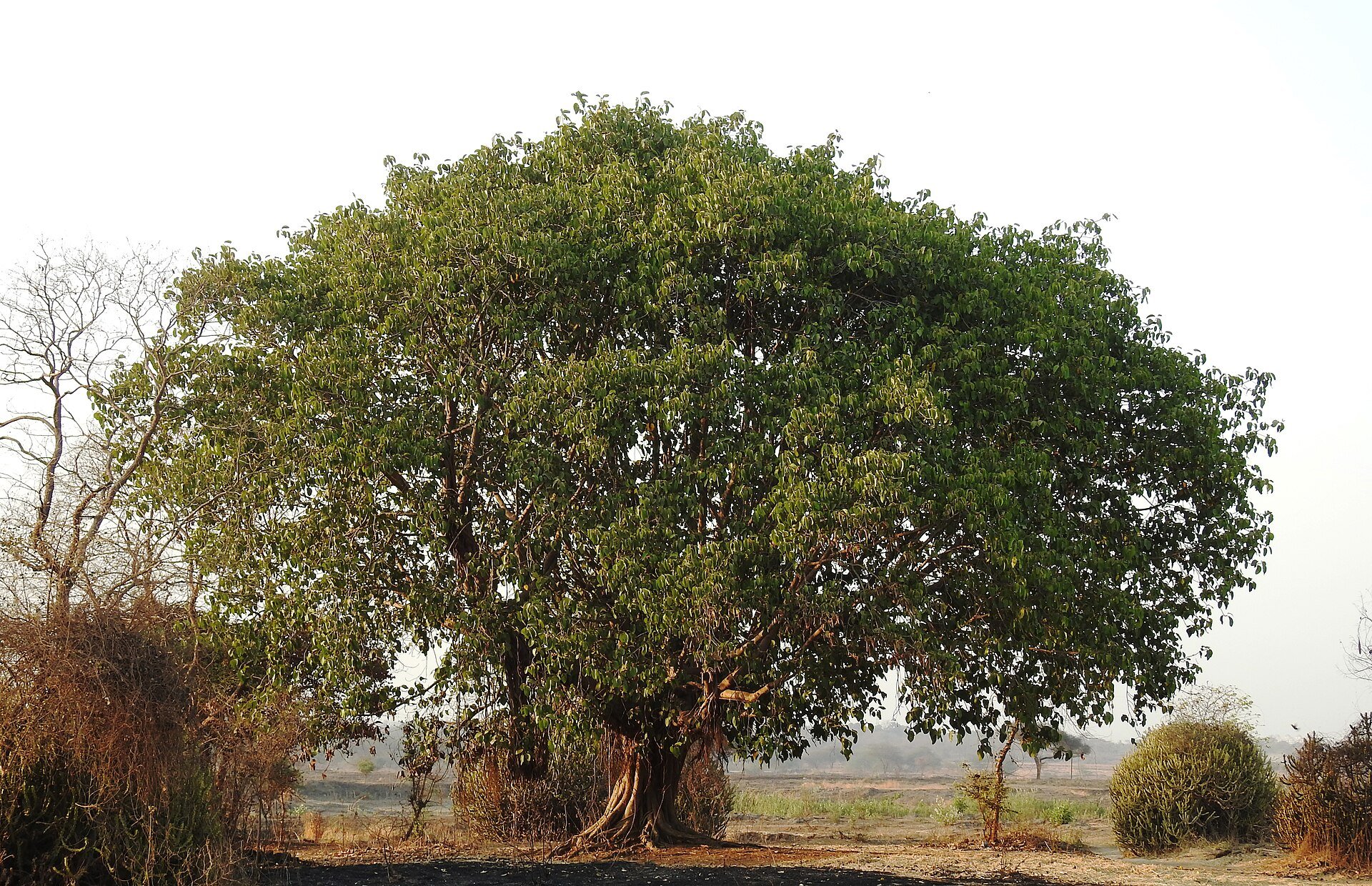
The Bargad, or banyan (Ficus benghalensis), is India's national tree and one of the largest shade trees in the country. Its hanging aerial roots slowly grow down into new trunks, so a single tree can, over many decades, become a shady grove. In Rajasthan it has long been the village meeting place, and with early care it grows well around Jaipur, as long as it is given a lot of open space.
Photo: Dr. Raju Kasambe, CC BY-SA 4.0, via Wikimedia Commons
Quick facts
| Scientific name | Ficus benghalensis L. |
| Family | Moraceae (fig family) |
| Hindi names | बरगद (Bargad), वट (Vat), बड़ (Bar) |
| Mature height | 20 to 30 m or more |
| Canopy | Very wide; keeps spreading as aerial roots become trunks |
| Lifespan | Very long-lived |
| Growth rate | Fast to moderate |
| Water need | Regular for the first 2 to 3 years; low to moderate once established |
| Leaves | Evergreen |
| Best planting months in Jaipur | July to mid-August (monsoon) |
| Jaipur suitability | Good, but only where there is a lot of open space |
Why plant a Bargad in Jaipur?
The banyan is not a desert specialist; in the wild it grows in monsoon and rain forests. But it tolerates most soils and, once established, it is drought tolerant with a moderate need for water. Large old banyans are a familiar sight across Rajasthan.
Few trees give as much shade or support as much wildlife. Its red figs feed many birds and bats.
The one real limit is size. It suits open fields, large campuses and village common land, not small gardens or roadside strips.
How to plant it
When to plant
The best time in Jaipur is July to mid-August, soon after the first soaking monsoon rains, so the roots get a full season before the dry months. February to early March is a second option, but only with reliable watering through the April to June heat. Avoid planting in April to June and in December to January.
Choosing a sapling
Seed germinates well and air-layering works, but small stem cuttings root poorly (about 18 to 20% survival in one Kerala trial). In practice, buy a nursery sapling about 1 to 1.5 m tall and 12 to 18 months old, in a large polybag.
The pit and the spot
- Dig a pit of about 60 × 60 × 60 cm, or 90 cm to 1 m deep where there is a hard kankar layer.
- Refill with the dug soil mixed with well-rotted farmyard manure, and plant at the same soil level as in the nursery bag.
- Make a basin 1 to 1.5 m across to catch rainwater (CAZRI's micro-catchment approach).
- Keep the tree at least 20 to 25 m from other large trees and from buildings, walls, borewells, tanks and pipelines.
- Fix a tree guard against goats, cattle and nilgai.
First-year watering (practical guide)
Adjust to soil moisture and never leave water standing.
| Season | How often | Amount |
|---|---|---|
| Monsoon (Jul to Sep) | Only after 7 to 10 dry days | 10 to 15 L |
| Post-monsoon (Oct to Nov) | Weekly | 15 to 20 L |
| Winter (Dec to Feb) | Every 10 to 14 days, in the morning | 10 to 15 L |
| Spring (Mar) | Weekly | 20 L |
| Summer (Apr to Jun) | Twice a week | 20 to 25 L |
Care in the first three years
These are practical suggestions for Jaipur conditions.
- Monsoon (Jul to Sep): Weed and repair the basin; widen it in year 3.
- Post-monsoon (Oct to Nov): Lay 8 to 10 cm of mulch, kept away from the stem. Water weekly in year 1, every 10 days in year 2, and every 2 to 3 weeks in year 3 if it is dry.
- Winter (Dec to Jan): Jaipur's record low is −2.2 °C. For the first two winters, cover saplings on cold-wave nights.
- Spring (Feb to Mar): Check for scale insects, mealybugs and thrips. In year 2, keep one strong leader and remove crossing shoots.
- Summer (Apr to Jun): Water twice a week in year 1, weekly in year 2 and every two weeks in year 3. Renew the mulch; if leaves scorch, add a shade net on the south-west side.
- All year: Check for termites at the base and keep the guard until the stem is beyond browsing height. Later, let a few aerial roots reach the ground where there is room.
Benefits
Shade and cooling. The banyan has an exceptionally wide, dense, evergreen canopy, which is why it has long been the shade and meeting place of Indian villages.
Birds, bats and wildlife. Many birds feed and roost in banyans. Fig trees in general are an important wildlife food: a global review recorded 1,274 bird and mammal species eating figs.
A special pollinator partnership. The banyan is pollinated only by its own tiny fig wasp, Eupristina masoni. The tree and the wasp depend on each other.
Soil and land. It is planted for soil conservation and reforestation, and its leaf litter adds organic matter to the soil.
Fodder and everyday uses. The leaves are lopped for fodder. In India they are also traditionally used as eating plates, and the figs have been used to make sherbet.
Traditional medicine. The bark, latex and aerial roots are traditionally used in Ayurveda and Unani medicine for digestive, skin and inflammatory complaints. This is traditional use only, not medical advice.
Dust. Its large leaf area traps dust, and banyan appears in India's green-belt guidance for polluted areas.
Cultural significance
The banyan is India's national tree. In Hindu tradition the vat is sacred and is often planted near temples. In many regions, married women observe Vat Savitri (Vat Purnima) by worshipping the banyan and tying threads around it. Because it keeps spreading through its aerial roots, it has become a symbol of long life. It is also sacred to Buddhists, and village gatherings and markets have traditionally been held in its shade.
Cautions and safety
- Size. This is the biggest issue. Plant a banyan only where it can spread 25 m or more for generations. The ICRAF Agroforestree Database calls it unsuitable for urban landscapes because of its immense size and extensive roots.
- Roots and buildings. Banyan often sprouts on walls or other trees and can crack or strangle them.
- Aerial roots need room. Do not plant it beside paths or roads where the roots would have to be cut.
- Milky latex. The white sap can irritate skin and eyes. Wear gloves when pruning.
- Pets. The ASPCA lists Ficus species as toxic to dogs, cats and horses. This is a general warning for the whole fig group, not a specific study of the banyan.
- A permanent commitment. Cutting or heavily lopping a banyan is socially sensitive. Choose land where it can stay for a hundred years or more.
The banyan is listed as Least Concern on the IUCN Red List and is native to the Indian subcontinent.
Plant a Bargad in someone's name with GreenEye: Gift a Tree
Planting calendar
- Northwest arid · Monsoon · Jul, Aug
- Northwest arid · Spring · Feb, Mar
Planting methods
SaplingPrimary method
Seed
Air layering
Cutting
Benefits
- Shade and cooling: An exceptionally wide, dense evergreen canopy; a traditional shade and meeting place in Indian villages.
- Biodiversity: Many birds feed and roost in banyans, and bats eat its figs. A global review recorded 1,274 bird and mammal species eating figs.
- Pollinators: Pollinated only by its own fig wasp, Eupristina masoni; the tree and the wasp depend on each other.
- Soil health: Planted for soil conservation and reforestation; leaf litter adds organic matter.
- Fodder: Leaves are lopped for livestock fodder.
- Edible: Leaves are traditionally used as eating plates, and the figs have been used to make sherbet. Not a mainstream food.
- Medicinal: Bark, latex and aerial roots are traditionally used in Ayurveda and Unani for digestive, skin and inflammatory complaints. Traditional use only, not medical advice.
- Air quality: Its large leaf area traps dust, and it appears in India's green-belt guidance for polluted areas.
- Cultural: India's national tree; sacred in Hindu and Buddhist traditions and worshipped on Vat Savitri.
Frequently asked questions
Why is the Bargad called India's national tree?
Its spreading roots and long life symbolise unity and endurance, and it is part of Indian culture everywhere.
How big will it get?
Very big: 20 to 30 m tall, with a crown that keeps spreading for decades. That is why it should be planted in open land.
When will it give shade?
As a rough estimate, about 5 to 8 years after planting a 1 to 1.5 m sapling, with good care.
Do the hanging roots harm the tree?
No. They are aerial roots that can grow into new supporting trunks.
Can it survive Jaipur's heat and dry years?
Yes, once established. It needs regular watering for the first 2 to 3 years.
Sources
- Orwa C. et al. (2009). Agroforestree Database 4.0: Ficus benghalensis. ICRAF
- Flowers of India: Banyan Tree
- NParks Flora & Fauna Web (Singapore): Ficus benghalensis
- TNAU Agritech: Neem, A Versatile Tree (dry-zone planting practice)
- The micro-catchment water harvesting technique for the plantation of jujube (Zizyphus mauritiana) in an agroforestry system under arid conditions (CAZRI study, via ResearchGate)
- Mathew G., Joseph A. et al. (2011). Standardization of conventional propagation techniques for four medicinal species of genus Ficus
- IMD Jaipur: Climatological table 1991-2020
- Tyagi A., Singh O.P. et al. Climate of Jaipur. IMD
- Shanahan M. et al. (2001). Fig-eating by vertebrate frugivores: a global review. Biological Reviews 76
- CPCB (2000). Guidelines for Developing Greenbelts
- Wikipedia: Ficus benghalensis (national tree)
- Wikipedia: Vat Purnima
- ASPCA Animal Poison Control: Weeping Fig (Ficus sp.)
- GBIF species API: IUCN category for Ficus benghalensis
This article was prepared with AI assistance. Please verify important details with the sources listed.
Plant a tree you can track
Plant a tree on GreenEye land and track it as it grows.
Share this article