Rohida Tree (Tecomella undulata): Rajasthan's State Flower and How to Grow It in Jaipur
Tecomella undulata (Sm.) Seem.
Rohida gives Rajasthan its state flower and the Thar its main native timber, and it is now Endangered. When to plant it in Jaipur, how to water and protect it for three years, what it does for birds and soil, and what to watch out for.
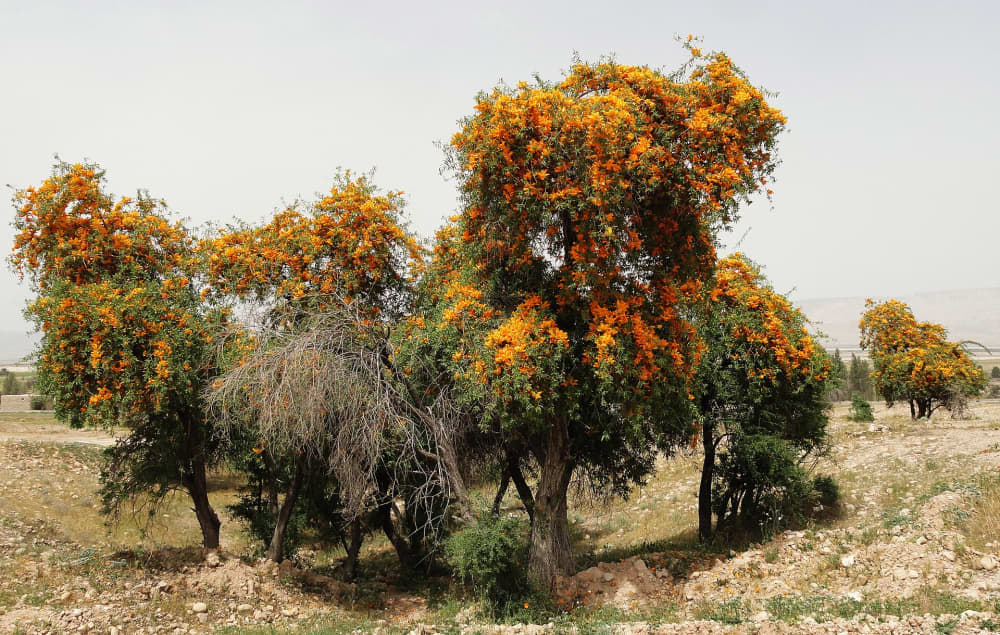
Rohida (Tecomella undulata) is the tree behind Rajasthan's state flower. For most of the year it is an easy tree to walk past: grey-green, with drooping branches and narrow leaves that have wavy edges. Then, in spring, it fills with clusters of trumpet-shaped flowers in yellow, orange or deep red, and the bulbuls arrive. It is also one of the best native timber trees of the Thar, which is exactly why wild Rohida has become scarce.
Photo: "Tecomella undulata tree in Alamarvdasht, Fars, Iran" by Hadi Karimi, CC BY 3.0, via Wikimedia Commons
Quick facts
| Scientific name | Tecomella undulata (Sm.) Seem. |
| Family | Bignoniaceae (jacaranda family) |
| Hindi name | रोहिड़ा (Rohida), also रोहेड़ा (Roheda) |
| Other names | Desert teak, Marwar teak, Honey tree, Rohitaka (Ayurveda) |
| Height | Usually 4–10 m; about 8 m in the wild |
| Growth rate | Slow |
| Flowers | Spring, roughly February to April; yellow, orange or red |
| Water need | Low once established |
| Best planting months in Jaipur | July–August (monsoon) |
| Jaipur suitability | Good, on well-drained land |
| Conservation status | Endangered (IUCN Red List, 2021) |
Why plant Rohida in Jaipur
Rohida belongs to the dry belt that runs from Oman and southern Iran through Pakistan into north-west India. In India most wild trees grow in western Rajasthan, from Barmer and Jaisalmer to Churu and Sikar, and it has also been recorded around Jaipur.
In its home range it lives on 150–500 mm of rain a year and puts up with winter nights of 0 to −2 °C and summer days of 48–50 °C. It does best on well-drained sandy loam or loam, and it grows happily on old, stabilised sand dunes.
Jaipur fits most of this. Summers regularly cross 45 °C, the record low is −2.2 °C, and the sandy soils on the city's edge are close to Rohida's wild ground. The one real difference is rain: about 600–630 mm in a normal year, more than the tree usually sees. On sandy or sloping land that is fine, but keep it away from low corners where monsoon water stands for days.
There is a bigger reason to plant it. The IUCN lists Rohida as Endangered. Trees have been cut for timber faster than they come back, young plants are grazed down, and the seed ripens just as the monsoon begins, so much of it rots before it can sprout.
How to plant Rohida
When to plant
Plant in July or August, once the monsoon has properly soaked the ground; published cultivation guidance for the species gives the same months. Avoid October to February, when a new sapling meets cold nights before it has rooted, and April to June.
Choosing a sapling
Look for a one-year-old nursery plant in a polybag, and ask for it by its botanical name. Many garden nurseries sell "Tecoma" or yellow bells (Tecoma stans), which is a different plant: a shrub with bright yellow bells that flowers from early summer to late autumn. Rohida is hard to root from stem cuttings, so honest nursery stock is grown from seed.
Some foresters plant "stumps" instead: a pencil-thick, one-year-old seedling trimmed to 2–5 cm of shoot and 15–20 cm of taproot. In a two-year trial at the Agricultural Research Station, Keshwana (Jalore), stumps and normal seedlings all survived, and the thickest stumps grew about 44% taller, with straighter stems.
Pit, spacing and protection
- Pit: 60 × 60 × 60 cm, refilled with the dug soil and well-rotted farmyard manure. Plant at nursery-bag level and shape a basin to catch rain. On termite-prone land, add a handful of neem cake (practical advice).
- Spacing: about 3 × 4 m in a block planting. For a single tree with a full crown, keep 5–6 m clear around it (practical advice).
- Guard: do not skip it. Goats, cattle and sheep browse young Rohida, and a plant that is nibbled back again and again ends up as a low bush instead of a tree. On Jaipur's outskirts, nilgai are another risk.
First-year watering (practical advice)
| Season | How often | Amount |
|---|---|---|
| Monsoon (Jul–Sep) | Only after 10 dry days | 10 L |
| Post-monsoon and winter (Oct–Feb) | Every 15–20 days | 10 L |
| Spring (Mar–Apr) | Every 10 days | 15 L |
| Summer (May–Jun) | Every 5–7 days | 15–20 L |
Water early in the morning or in the evening, and never let water stand around the stem.
Care in the first three years
Watering. Ease off each year. Published guidance suggests every 30–40 days in winter and every 20–30 days in summer once plants are established; treat that as the target for year two. By year three, water only in a long dry spell or a very hot May.
Frost. Grown trees handle light frost, but a first-winter sapling is small and exposed. On nights when IMD warns of a cold wave or ground frost, cover it loosely with jute or a straw hood and take the cover off in the morning.
Winter leaf drop. From November to March Rohida sheds part of its leaves, and new leaves start to appear from mid-February. A thin-looking tree in January is normal.
Weeds and mulch. Weed the basin in the first two monsoons, then mulch with dry grass, kept a hand's width from the stem.
Shaping. Rohida branches early and low, which is why so many old trees are short and crooked. From year two, remove the lowest side shoots a few at a time to build one clear stem. Use sharp secateurs and make clean cuts: canker fungi, borers and heart rot are known problems in older trees.
Pests. Termites and stem borers are the main pests of young plants. Check the base of the stem every few weeks.
Patience. In the Jalore trial, seedlings were under a metre tall after two years. Plant Rohida for the next generation, not for quick shade.
Benefits
Flowers and birds. The tubular flowers are 5–7 cm long and full of nectar. Field notes from the Rajasthan Biodiversity Network describe the red-vented bulbul pushing its head deep into the flower and pollinating it, while the purple sunbird often pierces the flower's base and steals the nectar. The old name "honey tree" suits it.
Shelter. It is known as a home for birds and other desert wildlife, and its shade shelters cattle, goats and sheep on summer days.
Holding the soil. A network of lateral roots close to the surface binds loose topsoil, and it is planted as a windbreak and to steady shifting sand dunes.
Fodder. Cattle and goats eat the leaves, and camels, goats and sheep eat the flowers and pods.
Timber. The wood is strong, tough and durable and takes a fine finish, which is how it earned the name Marwar teak. It has long been used for furniture, carving and farm implements. If you plant one, let it stand: wild Rohida has been cut far faster than it regrows.
Traditional use. The bark, called Rohitaka in Ayurveda, has a long history in traditional and folk medicine, and the plant has a monograph in the Ayurvedic Pharmacopoeia of India. This is traditional use only, not medical advice.
Cultural significance
Rohida is Rajasthan's state flower. In Marwar and Shekhawati it is one of the few trees that colours the dry country in spring, and its timber was valued enough to be compared with teak. Its decline has worried foresters for years: in the early 2000s, at the Rajasthan Forest Department's request, the Arid Forest Research Institute (AFRI) in Jodhpur selected 65 superior trees and collected their seed to raise better planting stock.
Cautions and safety
- It is endangered. Buy saplings from a forest-department or other reputable nursery. Never dig up wild seedlings.
- Toxicity is not well studied. Livestock eat the leaves, flowers and pods, but there is little data on people, cats or dogs. A 2025 review called it reasonably safe on preliminary evidence and asked for more research. Do not eat any part of it or give bark preparations to children or animals.
- Wet feet. Rohida is a dry-country tree. Avoid low spots, lawns that are sprinkled every day, and the area around leaking tanks.
- Check the label. Yellow bells (Tecoma stans) is often sold under similar names. Ask for Tecomella undulata.
- Plan for a slow, small tree. It suits farm boundaries, school grounds and larger home gardens.
Plant a tree in someone's name with GreenEye: Gift a Tree
Planting calendar
- Northwest arid · Monsoon · Jul, Aug
Planting methods
SaplingPrimary method
Seed
Cutting
Benefits
- Ornamental: Bunches of showy tubular flowers, 5-7 cm long, in yellow, orange or red each spring.
- Pollinators: Nectar-rich flowers: the red-vented bulbul feeds from them and pollinates the tree; purple sunbirds also visit. Hence the name 'honey tree'.
- Biodiversity: Known as a home for birds and a shelter for other desert wildlife.
- Shade and cooling: Its crown gives summer shade to resting cattle, goats and sheep.
- Soil health: A network of lateral roots near the surface binds loose topsoil.
- Other: Planted as a windbreak and to stabilise shifting sand dunes.
- Fodder: Cattle and goats eat the leaves; camels, goats and sheep eat the flowers and pods.
- Timber: Strong, tough, durable wood that takes a fine finish ('Marwar teak'), used for furniture, carving and farm implements. Overcutting is a main reason it is now endangered.
- Medicinal: The bark (Rohitaka) is used in Ayurveda and folk medicine and has a monograph in the Ayurvedic Pharmacopoeia of India. Traditional use only, not medical advice.
- Cultural: Rajasthan's state flower, and the tree that brings spring colour to Marwar and Shekhawati.
Frequently asked questions
Will Rohida grow in Jaipur?
Yes, on well-drained land. It is a desert tree of western Rajasthan and has been recorded around Jaipur. Avoid low spots where rainwater stands.
When does Rohida flower?
In spring, roughly February to April, in yellow, orange or red depending on the tree. How many years a young plant takes to flower for the first time is not well documented.
Why does my Rohida look thin in winter?
Rohida sheds part of its leaves between November and March, and new leaves start appearing from mid-February. This is normal.
Why is Rohida endangered?
It has been cut for its valuable timber faster than it can regrow. Young plants are grazed, seed often rots because it ripens just as the monsoon begins, and the tree grows slowly. The IUCN lists it as Endangered.
Can I use Rohida bark as medicine?
The bark has a long traditional use in Ayurveda, but please consult a qualified doctor before using any preparation. Do not strip bark from living trees; it harms an already endangered species.
Sources
- https://www.iucnredlist.org/species/137731325/169300279
- https://api.gbif.org/v1/species/4093643/iucnRedListCategory
- https://www.flowersofindia.net/catalog/slides/Roheda.html
- https://pmc.ncbi.nlm.nih.gov/articles/PMC12665970/
- https://en.vikaspedia.in/viewcontent/agriculture/crop-production/package-of-practices/medicinal-and-aromatic-plants/tecomella-undulata-1?lgn=en
- https://sdiopr.s3.ap-south-1.amazonaws.com/2024/Dec/16_Dec_24/2024_JABB_127602/Ms_JABB_127602.pdf
- https://www.icfre.org/UserFiles/File/annual_report-English-2007-08/Ch-3.6.pdf
- https://rajasthanbiodiversity.org/rohida-flowers-and-the-nectar-robber-sunbird-an-interesting-story-of-pollination/
- https://pmc.ncbi.nlm.nih.gov/articles/PMC12240331/
- https://www.plantsofrajasthan.com/tecomella-undulata-sm-seem/
- https://link.springer.com/article/10.1007/s10722-014-0140-3
- https://mausam.imd.gov.in/jaipur/mcdata/extreme_jaipur.pdf
- https://mausam.imd.gov.in/jaipur/docs/climate.pdf
- https://www.flowersofindia.net/catalog/slides/Yellow%20Bells.html
This article was prepared with AI assistance. Please verify important details with the sources listed.
Plant a tree you can track
Plant a tree on GreenEye land and track it as it grows.
Share this article