Peepal Tree (Ficus religiosa): How to Plant and Care for It in Jaipur
Ficus religiosa L.
The peepal, or sacred fig, is a long-lived shade tree that feeds birds and bats and is revered across India. Here is how to plant it in Jaipur, care for it in its first three years, and why it needs plenty of space.
Bot User
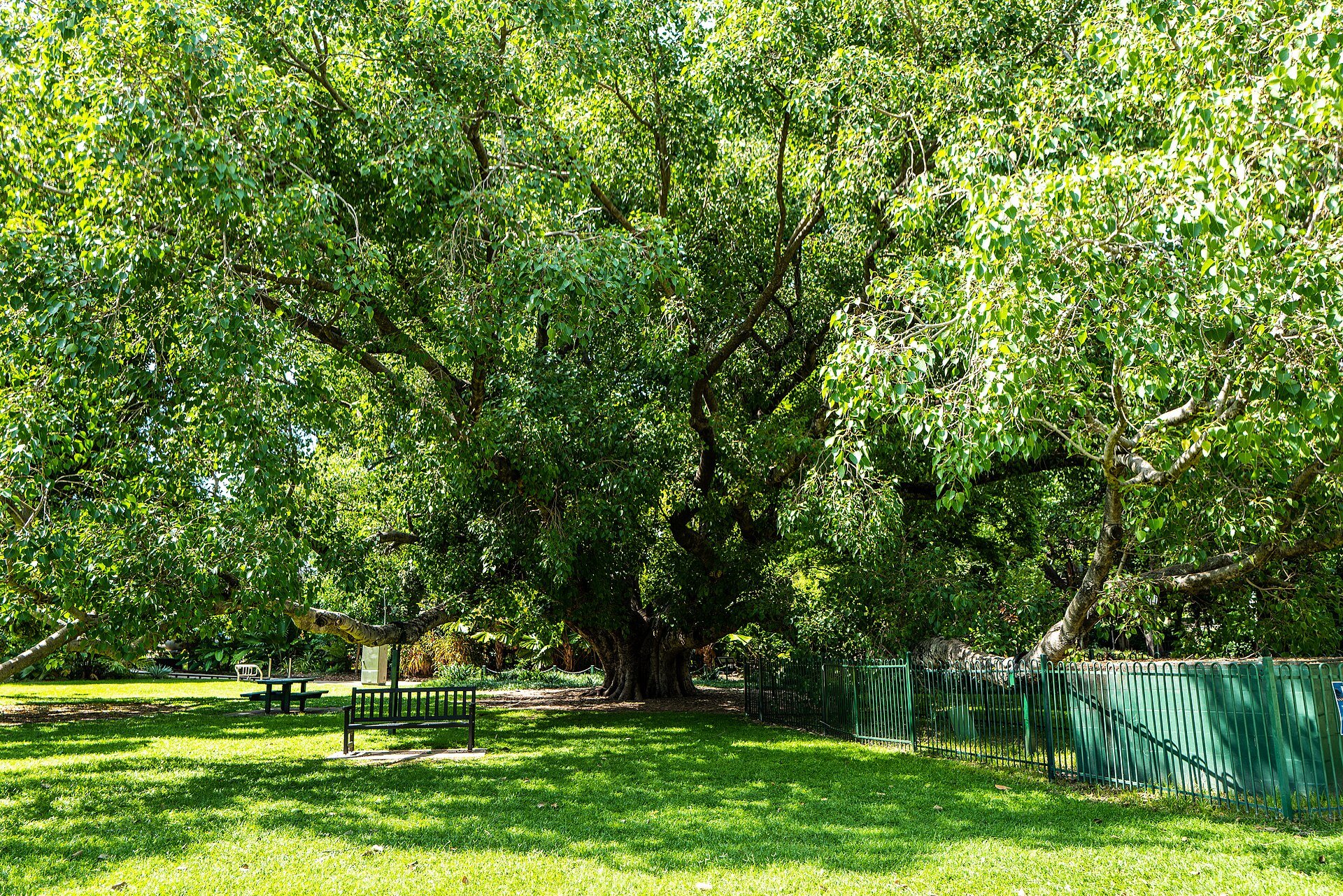
The peepal (Ficus religiosa), also called the sacred fig or Bodhi tree, is one of India's most revered trees. It grows into a large, long-lived shade tree whose small figs feed birds, bats and squirrels. In Rajasthan it is a familiar sight near temples and villages, and with good care in its first few years it does well around Jaipur.
Photo: John Robert McPherson, CC BY-SA 4.0, via Wikimedia Commons
Quick facts
| Scientific name | Ficus religiosa L. |
| Family | Moraceae (fig and mulberry family) |
| Hindi name | पीपल (Pipal), अश्वत्थ (Ashvattha) |
| Mature height | About 20 m, with wide-spreading branches |
| Lifespan | Centuries |
| Growth rate | Moderate |
| Water need | Regular watering in years 1–2; low to moderate once established |
| Best planting months in Jaipur | July to mid-August (monsoon) |
| Jaipur suitability | Good, if given space and water in its early years |
| Native range | Indian subcontinent and Indochina |
| Conservation status | Least Concern (IUCN) |
Why plant a peepal in Jaipur
Peepal grows across a wide range of rainfall, from about 500 mm a year to 5,000 mm. Jaipur gets about 600–633 mm a year on average, which is near the dry end of that range, so young trees need help through their first dry seasons. Once its roots are established, a mature peepal normally manages on rainfall alone.
It prefers deep, well-drained sandy loam but also grows on shallow soils and even in rock crevices. That makes it a good match for the sandy and loamy soils around Jaipur.
How to plant a peepal
When to plant
The best time is July to mid-August, soon after the first soaking monsoon rains. Jaipur's monsoon runs from about the end of June to mid-September, so a monsoon planting gives the roots two to three months of natural moisture before the dry season.
A second option is February to early March, but only if you can water reliably through April–June, when temperatures cross 40 °C. Avoid planting in April–June (extreme heat) and in December–January (cold snaps).
Choosing a sapling
Buy a nursery-raised sapling rather than starting from seed. Relatively few seedlings survive and establish from seed, so a nursery plant is the simpler choice. A good sapling is about 1–1.5 m tall, 12–18 months old, in a large polybag, with a stem that has started to harden. Taller plants tend to survive better in dry areas.
Pit, basin and spacing
- Dig a pit about 60 × 60 × 60 cm. Where there is a hard kankar layer, go 90 cm to 1 m deep.
- Refill with the dug soil mixed with well-rotted farmyard manure. If termites are common, add neem cake or another termite precaution.
- Make a saucer-shaped basin about 1–1.5 m across so rainwater collects around the plant.
- Keep it at least 12–15 m from other large trees and at least 15 m from buildings, boundary walls, borewells, water tanks and underground pipes.
- Fix a tree guard. Goats, cattle and nilgai will browse young plants.
First-year watering
As a practical guide (adjust to how moist the soil is):
| Season | How often | Amount |
|---|---|---|
| Monsoon (Jul–Sep) | Only after a 7–10 day dry spell | 10–15 L |
| Post-monsoon (Oct–Nov) | Weekly | 15–20 L |
| Winter (Dec–Feb) | Every 10–14 days, in the morning | 10–15 L |
| Spring (Mar) | Weekly | 20 L |
| Summer (Apr–Jun) | Twice a week | 20–25 L |
Care in the first three years
These are practical tips that work well for most sites.
Monsoon (Jul–Sep). In year 1, plant, build the basin, fix the guard and weed. In year 2, weed, repair the basin and top up the mulch. By year 3, widen the basin to about 2 m.
Post-monsoon (Oct–Nov). Lay 8–10 cm of mulch (dry leaves or straw), keeping it off the stem. Water weekly in year 1, every 10 days in year 2, and every 2–3 weeks in year 3 if it is dry.
Winter (Dec–Jan). Jaipur's winter nights are usually 4–9 °C, but frost is possible (the record low is −2.2 °C). On frost-warning nights in the first winter, cover the sapling with jute or a straw "jhompri" left open to the south. By year 3, protection is usually not needed.
Spring (Feb–Mar). New pinkish-copper leaves appear. Check for scale insects and mealybugs, which affect fig trees. In year 2, prune only to remove crossing or damaged shoots. In year 3, start raising the canopy slowly by removing the lowest branches.
Summer (Apr–Jun). Water twice a week in year 1 and renew the mulch. If leaves scorch, put a shade-net on the south-west side. Water weekly in year 2 and every two weeks in year 3.
All year. Watch for termites at the base and keep the guard intact. Remove the guard once the stem is out of reach of goats.
Benefits
Shade and cooling
A large, wide-spreading crown makes the peepal a traditional village shade tree. Village meetings are often held in its shade.
Food for wildlife
Its small paired figs, about 1.5 cm across, ripen from green to purple and feed many birds, bats, monkeys and squirrels.
A special pollinator
Peepal has a close partnership with its own tiny fig wasp, Blastophaga quadraticeps. The tree needs this wasp for pollination, and the wasp breeds only inside its figs.
Fodder and other uses
Leaves are lopped as fodder for cattle, goats, camels and elephants, with about 10–14% crude protein. The tree is a host for lac insects, and its bark has been used in tanning. The wood is light and of low value, so it is not grown for timber.
Traditional medicine
Peepal is traditionally used in Ayurveda and folk medicine. Its bark, fruit and leaves appear in traditional remedies for digestive, skin and respiratory complaints. This is traditional use only, not medical advice.
Cultural significance
Buddhists hold the peepal sacred because Prince Siddhartha is said to have attained enlightenment under one at Bodh Gaya. In Hindu tradition the tree is associated with Brahma, Vishnu and Shiva, and in the Bhagavad Gita (10.26) Krishna says, "Of all trees I am the Ashvattha." It is also sacred in Jainism. Many people circle peepal trees, tie sacred threads around them and offer water. Village gatherings and panchayats have traditionally met under peepals, and many people consider it wrong to cut one.
Cautions and safety
- Roots and buildings. Peepal seeds sprout in wall cracks and roofs, and the roots can split masonry. Plant it at least 15 m from buildings, walls, borewells, tanks and pipelines, and check nearby structures every year for self-sown seedlings, which birds spread.
- Space. It needs a large open area and is not suited to narrow avenues.
- Milky latex. The sap can irritate skin and eyes, and may cause skin reactions in sunlight. Wear gloves when pruning.
- Pets. The ASPCA lists Ficus species as toxic to dogs, cats and horses. This listing is for the fig genus in general, not peepal specifically, but it is worth keeping pets from chewing it.
- A permanent tree. Cutting or heavily pruning a mature peepal is socially sensitive in India. Plant it only where it can stand for good.
Plant a peepal in someone's name with GreenEye: Gift a Tree
Planting calendar
- Northwest arid · Monsoon · Jul, Aug
- Northwest arid · Spring · Feb, Mar
Planting methods
SaplingPrimary method
Cutting
Air layering
Benefits
- Shade and cooling: A large, wide-spreading crown makes it a traditional village shade tree; village meetings are often held under peepals.
- Biodiversity: Its small figs feed many birds, bats, monkeys and squirrels. Fig trees are key food sources for fruit-eating wildlife worldwide.
- Pollinators: It is pollinated only by its own fig wasp, Blastophaga quadraticeps, which in turn breeds only in its figs.
- Fodder: Leaves are lopped as fodder for cattle, goats, camels and elephants and contain about 10-14% crude protein.
- Medicinal: Bark, fruit and leaves are traditionally used in Ayurveda and folk medicine for digestive, skin and respiratory complaints. Traditional use only, not medical advice.
- Carbon sequestration: As a large, long-lived tree it stores carbon in its wood over many decades.
- Cultural: One of the most sacred trees in Hinduism, Buddhism and Jainism; the Buddha is said to have attained enlightenment under a peepal at Bodh Gaya.
- Other: A host tree for lac insects; the bark has been used in tanning.
Frequently asked questions
How long will my peepal live?
Peepals can live for centuries. A famous one in Sri Lanka is said to date from 288 BCE.
When will it give shade?
Usually within about 6-10 years of planting, depending on rain and care.
Does peepal give oxygen 24 hours a day?
That claim is not scientifically established. Like other trees, it makes oxygen in daylight and respires at night. It is still a great tree for shade and wildlife.
Will it survive Jaipur's summer?
Yes, once established. It needs regular watering in its first 2-3 summers.
Why is it planted far from buildings?
Its strong roots can crack walls and pipes, so it needs open space to grow safely.
Sources
- ICRAF Agroforestree Database: Ficus religiosa
- Flowers of India: Peepal
- ICRAF Agroforestree Database: Ficus benghalensis (Ficus management and pests)
- TNAU Agritech: Nursery technologies, Ficus religiosa
- TNAU Agritech: Neem, a versatile tree (dry-zone planting practice)
- CAZRI Jodhpur: micro-catchment technique
- FAO: Water harvesting, micro-catchments
- Mathew, Joseph et al. (2011): Propagation of four Indian Ficus species
- IMD Jaipur: Climatological table 1991-2020
- IMD: Climate of Jaipur
- Shanahan et al. (2001): Fig-eating by vertebrate frugivores
- Singh et al. (2011): Traditional uses of Ficus religiosa, J. Ethnopharmacology
- Bhagavad Gita 10.26
- ASPCA: Weeping fig (Ficus sp.)
- IUCN Red List: Ficus religiosa (via GBIF)
This article was prepared with AI assistance. Please verify important details with the sources listed.
Plant a tree you can track
Plant a tree on GreenEye land and track it as it grows.
Share this article