Neem Tree (Azadirachta indica): How to Grow and Care for It in Jaipur
Azadirachta indica A.Juss.
Neem is one of the toughest trees for Rajasthan's heat, low rainfall and alkaline soil. Learn when to plant it in Jaipur, how to protect young saplings from frost, its benefits and traditional uses, and why neem oil must never be swallowed.
Bot User
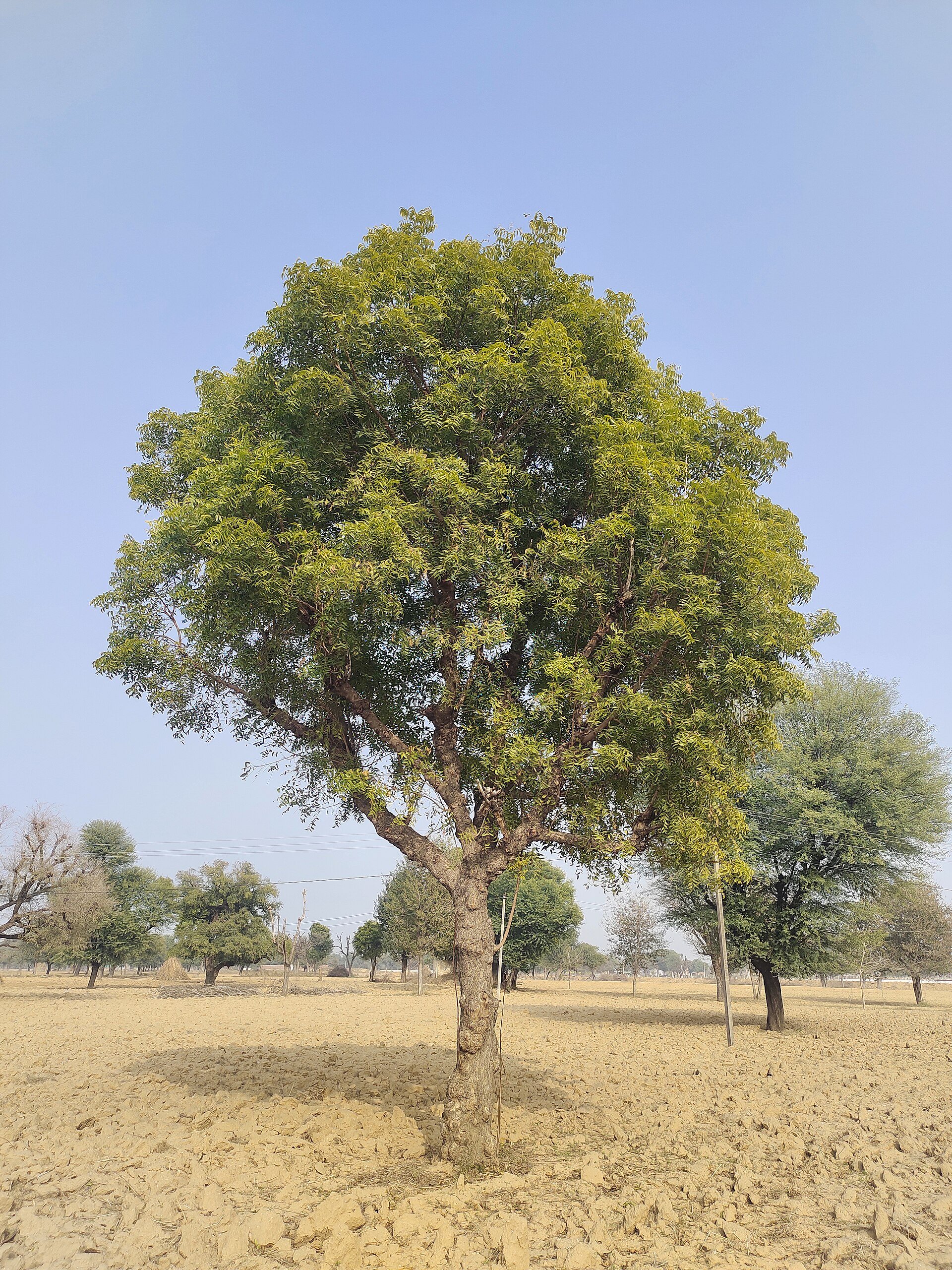
Neem (Azadirachta indica) is one of the toughest trees you can plant in Rajasthan. It handles fierce summer heat, low rainfall and poor, alkaline soil, and it grows quickly into a rounded, evergreen shade tree. For centuries it has been part of Indian village life, and a well-cared-for neem can stand for a hundred years or more.
Photo: TheSlumPanda, CC BY-SA 4.0, via Wikimedia Commons
Quick facts
| Scientific name | Azadirachta indica A. Juss. |
| Family | Meliaceae (mahogany family) |
| Hindi name | नीम (Neem) |
| Other names | Indian lilac, Margosa, Nimba (Sanskrit) |
| Mature height | Usually 12–18 m in India (up to 30 m) |
| Canopy | Round crown about 10 m wide (up to 20 m) |
| Lifespan | 100 to 200+ years |
| Growth rate | Fast when young |
| Water need | Moderate for the first 2 years, low once established |
| Best planting months in Jaipur | July to mid-August (monsoon) |
| Jaipur suitability | Excellent |
| Conservation status | Least Concern (IUCN Red List) |
Why plant neem in Jaipur
Neem is native to the Indian subcontinent and Myanmar, and it is at home in dry country. It does well where annual rainfall is 400–1,200 mm. Jaipur gets about 600–633 mm a year, comfortably inside that range. It thrives where daytime temperatures reach 50 °C, and Jaipur's record high is 48.5 °C.
Neem grows on neutral to alkaline soils up to about pH 10, including saline soils, and does better than most trees on shallow, stony, sandy ground, even over a hard kankar layer. Its deep roots draw water from lower soil layers, so it is drought-resistant once established.
There are two weak points. Neem quickly dies in waterlogged soil, and young plants are sensitive to frost. Jaipur's record low is −2.2 °C, and forestry trials at Jodhpur found frost damage on neem, so the first two winters need care.
How to plant neem
When to plant
The best time is July to mid-August, soon after the first soaking monsoon rains. This gives the roots time to grow before the dry season and the first cold spell.
February to early March also works, but only with regular watering through April–June. Avoid October to December, when the young tree would meet frost before it is established.
Choosing a sapling
Use a polybag nursery sapling. For dry areas, TNAU recommends saplings at least 45 cm tall, because smaller ones struggle through drought. In practice, a sapling 60–100 cm tall and 9–12 months old is a good choice.
Pit, spacing and protection
- Pit: dig at least 60 × 60 × 60 cm, and go to 1 m deep where you hit kankar. Refill with the dug soil mixed with farmyard manure.
- Site: never plant in a low spot where water collects.
- Spacing: 5 × 5 m for block planting, 7 × 7 m where crops or grass grow between trees. For a single shade tree, leave 8–10 m around it.
- Basin: shape a rain-catching basin 1–1.5 m across around the sapling, as recommended for arid-zone tree planting by CAZRI Jodhpur.
- Guard: fit a tree guard against goats, cattle and nilgai. Rats and porcupines sometimes gnaw young stems.
First-year watering (practical advice)
Adjust to how moist the soil is, and never leave standing water.
| Season | How often | Amount |
|---|---|---|
| Monsoon (Jul–Sep) | Only after a 10-day dry spell | 10 L |
| Post-monsoon (Oct–Nov) | Weekly | 10–15 L |
| Winter (Dec–Feb) | Every 2 weeks, in the morning | 10 L |
| Spring (Mar) | Weekly | 15 L |
| Summer (Apr–Jun) | Every 4–5 days | 15–20 L |
Care in the first three years
Weeding: young neem cannot withstand competition, especially from grasses. Weed twice in year 1 (during and after the monsoon) and once in year 2.
Monsoon (Jul–Sep): in year 1 plant, build the basin and fix the guard. Repair the basin in year 2 and widen it in year 3.
Post-monsoon (Oct–Nov): lay 8–10 cm of mulch in year 1, kept off the stem. Water weekly in year 1, every two weeks in year 2, and monthly in year 3 if it is dry.
Winter (Dec–Jan): in the first winter, cover the sapling at night with jute, a straw hood or a small hut open to the south whenever IMD issues a cold-wave or frost warning. Repeat on cold-wave nights in year 2. In year 3, simply trim any frost-killed shoot tips in March.
Spring (Feb–Mar): in dry spells neem may briefly drop most of its leaves. This is normal. Watch for scale insects, tea mosquito bug and shoot borer. In year 2, prune to one main stem and remove frost-damaged low branches.
Summer (Apr–Jun): water every 4–5 days in year 1, every 1–2 weeks in year 2, and in year 3 only in severe drought.
All year: do not over-water, check the base for termites and rodent damage, and remove the guard once the stem is above browsing height.
Benefits of neem
Shade and shelter
Its large crown makes neem a widely planted shade tree along avenues and in villages, and its low branches make it a good windbreak.
Soil and water
Farmers use neem cake (left after pressing oil from the seeds) as organic manure, and the leaves and twigs as mulch. Neem has also been used to fix sand dunes and control erosion.
Bees, birds and wildlife
The small, white, honey-scented flowers appear roughly between January and May and attract many honeybees. Birds and bats eat the fruit, which ripens around May to August, and spread the seeds.
Traditional uses
Neem is traditionally used in Ayurveda, Unani and folk medicine for skin and dental complaints, among others. Neem twigs are traditionally used as a tooth-cleaning stick (datun). This is traditional use only, not medical advice.
Farm uses
Seed extracts (azadirachtin) are a long-established natural insect repellent. The very bitter leaves are used as dry-season fodder. The wood is termite-resistant and is used for posts and furniture, although GreenEye's gift trees are planted to stand, not to be cut.
Neem is also widely used in green-belt plantings in India.
Cultural significance
Indian farmers have grown neem since the Vedic period, and it has become part of Indian culture. In parts of India, the new year at Ugadi and Gudi Padwa is marked by eating neem flowers or leaves with jaggery. The bitter-sweet mix stands for life's mix of experiences. Neem is also the state tree of Andhra Pradesh.
Cautions and safety
- Neem oil is dangerous if swallowed. Indian case reports describe seizures and severe metabolic acidosis in children after swallowing neem oil, including fatal cases. Never swallow it, and keep neem oil products away from children and pets.
- Frost is the main risk for young trees in Jaipur. Protect saplings in the first two winters.
- Waterlogging kills neem. Avoid low spots and areas near leaking tanks.
- Roots: neem has a deep taproot and is far less damaging to buildings than banyan or peepal. Even so, keeping it about 5 m from buildings and pipes is sensible.
- Self-seeding: birds spread the seeds, so seedlings may come up nearby. As a native tree, this is not a concern in India.
- Water life: neem extracts can harm fish, so do not pour them into ponds or drains.
Plant a neem in someone's name with GreenEye: Gift a Tree
Planting calendar
- Northwest arid · Monsoon · Jul, Aug
- Northwest arid · Spring · Feb, Mar
Planting methods
SaplingPrimary method
Seed
Cutting
Benefits
- Shade and cooling: A large crown makes neem a widely planted shade tree along avenues and in villages; its low branches also make it a useful windbreak.
- Soil health: Neem cake (the residue after oil extraction) is used by farmers as organic manure, and leaves and twigs as mulch and green manure. Deep roots bring up nutrients from lower soil layers.
- Water conservation: Drought-resistant and used for dune fixation and erosion control; needs little irrigation once established.
- Pollinators: Small, white, honey-scented flowers attract many honeybees, which pollinate the tree.
- Biodiversity: Birds and bats eat the fruit and spread the seeds.
- Medicinal: Traditionally used in Ayurveda, Unani and folk medicine for skin, dental and other complaints; twigs are a traditional datun (tooth-cleaning stick). Traditional use only, not medical advice. Neem oil must never be swallowed.
- Other: Seed extracts (azadirachtin) are a long-established natural insect repellent in agriculture.
- Fodder: The very bitter leaves are used as dry-season fodder.
- Timber: Termite-resistant wood used for posts and furniture. GreenEye gift trees are not planted for felling.
- Air quality: Widely used in green-belt plantings in India.
- Cultural: Grown by Indian farmers since the Vedic period; neem flowers or leaves with jaggery mark the new year at Ugadi and Gudi Padwa; state tree of Andhra Pradesh.
Frequently asked questions
Will neem survive in Jaipur?
Yes. It is one of the best trees for Rajasthan's heat, low rainfall and alkaline soils.
How fast does it grow?
Fast when young: roughly 4 m in 5 years in typical plantations, faster with good care.
Why does my neem look bare in spring?
In dry areas neem briefly sheds leaves around February–March, and new leaves follow soon after. This is normal.
Can I use neem from the tree as medicine?
Neem has a long traditional use, but please consult a qualified doctor. Neem oil must never be swallowed, especially by children.
How long will it live?
Typically over 100 years, and some trees live for 200 years or more.
Sources
- Orwa C. et al. (2009). Agroforestree Database 4.0: Azadirachta indica. ICRAF
- Flowers of India: Neem
- TNAU Agritech: Neem, a versatile tree
- TNAU Agritech, Forestry: Neem
- CAZRI Jodhpur: micro-catchment technique for arid-zone tree establishment
- IMD Jaipur: Climatological table 1991–2020
- Tyagi A., Singh O.P. et al. Climate of Jaipur. IMD
- Alzohairy M.A. (2016). Therapeutics role of Azadirachta indica (Neem). Evid.-Based Complement. Altern. Med
- CPCB (2000). Guidelines for Developing Greenbelts
- Wikipedia: Ugadi
- Dhongade R.K. et al. (2008). Neem oil poisoning. Indian Pediatrics 45: 56–57
- GBIF / IUCN Red List: Azadirachta indica (Least Concern)
This article was prepared with AI assistance. Please verify important details with the sources listed.
Plant a tree you can track
Plant a tree on GreenEye land and track it as it grows.
Share this article