Moringa (Sahjan): The Fast-Growing Drumstick Tree for Jaipur
Moringa oleifera
Sahjan (moringa) is a native, fast-growing food tree whose leaves, flowers and pods are traditional vegetables. Learn when to plant it in Jaipur, how to protect young plants from frost, and why it is a food tree rather than a big shade tree.
Bot User
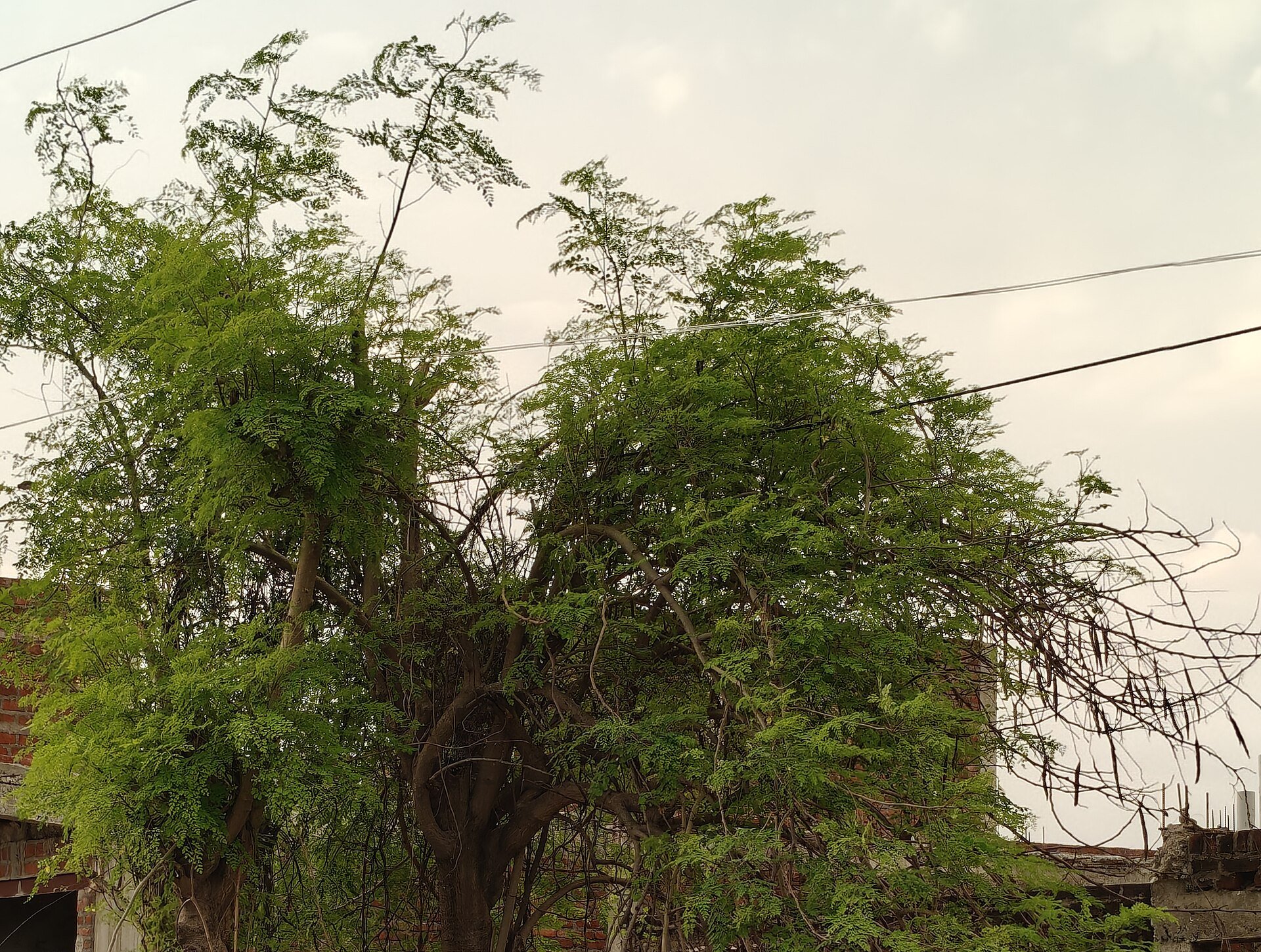
Sahjan, also called moringa or the drumstick tree, is a fast-growing tree native to north-west India. Its leaves, flowers and pods have been everyday vegetables in Indian homes for generations. It handles heat, dry spells and alkaline soil well, which makes it a practical food tree for Rajasthan.
Photo: "Drumstick tree (93961)" by Anushka10patel, CC BY-SA 4.0 (https://creativecommons.org/licenses/by-sa/4.0), via Wikimedia Commons (cropped)
Before you plant, know that Sahjan is a small-to-medium tree with a light, open crown, not a big shade tree like Neem, Peepal or Bargad.
Quick facts
| Scientific name | Moringa oleifera Lam. |
| Family | Moringaceae (a family with only one genus) |
| Hindi name | सहजन (Sahjan), सैजन (Saijan), मुनगा (Munga) |
| Other names | Drumstick tree, Horseradish tree; Shigru / Shobhanjana (Sanskrit) |
| Height | Usually about 6–10 m |
| Lifespan | Not well documented |
| Growth rate | Fast |
| Water need | Low once established; regular watering in years 1–2 |
| Best planting months in Jaipur | July–August (or February–March) |
| Jaipur suitability | Good for survival and food; not a large, long-lived shade tree |
Why plant Sahjan in Jaipur and Rajasthan
- It is native to India and Pakistan, growing naturally in north-west India.
- It copes with low rainfall. The ICRAF tree database calls it "quite drought tolerant", needing about 500 mm of rain a year. Jaipur gets about 600–650 mm.
- It has been tested in Rajasthan. A 2022–24 trial by Agriculture University Jodhpur in Jalore district (soil pH 8.1) found several varieties grew and yielded well.
- It tolerates alkaline soil, if the soil drains well.
The main risk in Jaipur is frost on young plants. A hard freeze can kill a young Sahjan back to the ground. It usually re-sprouts, but first-winter saplings need protection. Its other weak points are brittle branches and poor tolerance of waterlogging.
How to plant it
When to plant
- Best: July–August (monsoon). The sapling gets 4–5 months to grow before the cold; a bigger plant survives frost better.
- Second-best: February–March, after the frost risk, with regular watering through April–June.
- October is possible but not recommended: the sapling gets only 6–8 warm weeks before winter. If you must, use a large sapling (at least 90 cm), mulch heavily and cover it on cold nights.
- Avoid November–January (cold) and May–June (extreme heat), unless irrigation is reliable.
Step by step
- Choose a nursery seedling, 45–90 cm tall, with a straight taproot; seed-grown plants stand up to wind better. For a long-term tree, pick a local perennial type, not annual pod-crop varieties such as PKM-1, which are pruned low.
- Pick a sunny, well-drained spot, never where water collects. Keep it 3–4 m from buildings and away from paths and power lines, because branches can snap.
- Dig a pit 45 × 45 × 45 cm and refill with soil mixed with 10–15 kg of well-rotted compost or farmyard manure (add neem cake on termite-prone land).
- Plant at the same depth as in the nursery bag, 5–6 m apart in a grove.
- Protect it with a tree guard against goats and cattle, and stake it in windy spots; the young stem is fragile.
It can also be grown from seed (2 seeds per pit, 2.5–3 cm deep) or from thick limb cuttings 90–100 cm long.
Care in the first 3 years
Year 1
- Monsoon (Jul–Sep): Make a raised basin so water drains away from the stem. Water about 10 L only after 7–10 days without rain.
- Post-monsoon (Oct–Nov): Mulch 5–8 cm deep with dry grass or leaves. Water about 10 L every 10 days.
- Winter (Dec–Feb): Frost protection is critical. Cover the sapling with a jute or old-cloth hood on nights forecast below about 4 °C. Water lightly every 15–20 days; wet, cold soil invites root rot.
- Spring (Mar–Apr): About 15 L every week.
- Summer (May–Jun): The most critical time. 15–20 L every 4–5 days, morning or evening.
Year 2
Add about 10 kg of farmyard manure in the monsoon. Water every 2–3 weeks after the rains and every 7–10 days in summer. Cover it on very cold nights if still under 2 m. If frost kills the tops, wait until March, then cut back to live wood.
Year 3
Light shaping after the rains; water only in long dry spells. Dropping leaves in a dry spell is normal.
Pests and pruning
Watch for the hairy caterpillar, which can strip the leaves; pick off clusters wearing gloves, as the hairs irritate skin. For a tree form, remove only crossing or damaged branches.
Benefits
Food
The leaves, tender pods and flowers are traditional vegetables in India. According to the Indian Food Composition Tables 2017 (ICMR-NIN), per 100 g:
- Leaves: protein 6.41 g, fibre 8.21 g, calcium 314 mg, iron 4.56 mg, vitamin C 108 mg.
- Pods (drumsticks): protein 2.62 g, fibre 6.83 g, calcium 33.3 mg, vitamin C 71.9 mg.
It is a nutritious food, not a cure for any illness.
Bees, soil and shade
The fragrant white flowers draw carpenter bees and sunbirds, and flowering on and off through the year gives honey bees nectar over a long period. Green leaves make a useful mulch. The open crown gives light, dappled shade and works as a windbreak or hedge.
Other uses
The seed oil ("ben oil") is used in cooking and cosmetics, and powdered seed is a traditional way to clear muddy water. Branches are sometimes lopped for camels and cattle. The wood is soft, fit only for light construction and firewood.
Cultural significance
In Ayurveda, Sahjan is known as Shigru or Shobhanjana and is traditionally used in Ayurveda for a range of conditions. Drumsticks and leaves are everyday vegetables in many Indian cuisines (for example, in sambar in the south), with local names in about 15 Indian languages. It has no significant role in religious worship.
Cautions and safety
- Do not eat the roots or bark. The leaves, tender pods and flowers are widely eaten, and a 2015 safety review found no adverse effects reported in human studies of the leaves at normal food amounts. But the roots contain a harmful alkaloid, and the gum is traditionally described as causing miscarriage. Avoid roots, bark and gum, especially during pregnancy.
- Animals: Cattle and camels eat the leaves, but seed meal proved toxic to rabbits. There is no information for dogs and cats.
- Brittle branches can snap in storms, and the tree rots in waterlogged soil.
Sahjan is native here and not a concern as an invasive in Rajasthan. Its IUCN status is Least Concern.
Plant a Sahjan in someone's name with GreenEye: Gift a Tree
Planting calendar
- Northwest arid · Monsoon · Jul, Aug
- Northwest arid · Spring · Feb, Mar
Planting methods
SaplingPrimary method
Seed
Cutting
Benefits
- Edible: Leaves, tender pods and flowers are traditional Indian vegetables. Per 100 g, the leaves have 6.41 g protein, 314 mg calcium, 4.56 mg iron and 108 mg vitamin C (ICMR-NIN, 2017).
- Pollinators: Its fragrant white flowers are visited mainly by carpenter bees and also by sunbirds; flowering on and off through much of the year gives honey bees nectar over a long period.
- Soil health: Green leaves make a useful mulch, and the seed press-cake can be used as a soil conditioner or fertiliser.
- Shade and cooling: Gives light, dappled shade from an open crown and is used as a windbreak or hedge around homes. It is not a dense shade tree.
- Fodder: Branches are sometimes lopped for camels and cattle.
- Medicinal: Known in Ayurveda as Shigru; traditionally used in Ayurveda for a range of conditions. It is food, not a cure.
- Ornamental: Widely planted as an ornamental for its feathery foliage and fragrant flowers.
- Timber: The wood is very soft and light, useful only for light construction and as firewood.
- Cultural: A familiar vegetable across India, with Sanskrit names Shigru and Shobhanjana and local names in about 15 Indian languages.
- Other: Seed oil (ben oil) is used in cooking, cosmetics and as a lubricant; bark gives rope fibre; powdered seed is a traditional way to clear muddy water.
Frequently asked questions
Will my Sahjan become a big shade tree?
No. Sahjan is a small-to-medium tree, usually 6–10 m tall, with a light, feathery crown. It grows fast and is valued for its leaves, flowers and pods rather than deep shade.
Can it survive Jaipur's winter?
Established trees usually do. Young saplings can be damaged by frost, so cover them on cold nights in their first winter. If frost kills the top, it normally re-sprouts in spring.
When will it give drumsticks (pods)?
Special pod varieties can bear within a year, but a tree grown for the long term may take longer.
Is moringa healthy to eat?
Its leaves and pods are a traditional vegetable and contain protein, calcium, iron and vitamin C (ICMR-NIN data). It is food, not a cure for any illness.
How long will my tree live?
Moringa grows quickly, but its natural lifespan is not well documented and it is not one of the very long-lived trees. For a tree meant to stand for generations, consider Neem, Khejri or Peepal.
Sources
- Kew, World Checklist of Vascular Plants: Moringa oleifera
- Orwa C. et al. (2009), Agroforestree Database 4.0 (ICRAF): Moringa oleifera
- Longvah T. et al. (2017), Indian Food Composition Tables 2017, ICMR-NIN
- TNAU Agritech Portal, "Annual Moringa"
- TNAU / e-Agri HORT 281, Lecture 32, "Drumstick, Coccinea and Curry Leaf"
- Saresh N.V. et al. (2025), "Evaluation of Moringa oleifera varieties for pod yield and spacing in arid western Rajasthan, India", Plant Archives
- Feedipedia, "Moringa (Moringa oleifera)"
- Kamanga et al. (2026), "Cold Stress Responses and Adaptation Mechanisms in Moringa oleifera", Plants
- Soares et al. (2023), "Chilling and freezing stress tolerance in Moringa oleifera", Scientia Horticulturae
- CABI Compendium, Moringa oleifera
- Flowers of India, "Drumstick Tree"
- IUCN Red List category via GBIF
- Stohs S.J., Hartman M.J. (2015), "Review of the safety and efficacy of Moringa oleifera", Phytotherapy Research
- Soni P., Sharma M.M. (2022), "Moringa oleifera Lam.: a valuable medicinal plant", IJAPR
This article was prepared with AI assistance. Please verify important details with the sources listed.
Plant a tree you can track
Plant a tree on GreenEye land and track it as it grows.
Share this article