Ashoka (Mast Tree): How to Grow Monoon longifolium in Jaipur
Monoon longifolium
The tall, evergreen "Ashoka" or Mast tree seen along Indian roads. How to plant and care for it in Jaipur, what it offers birds and butterflies, and why it is not the true Ashoka (Saraca asoca).
Bot User
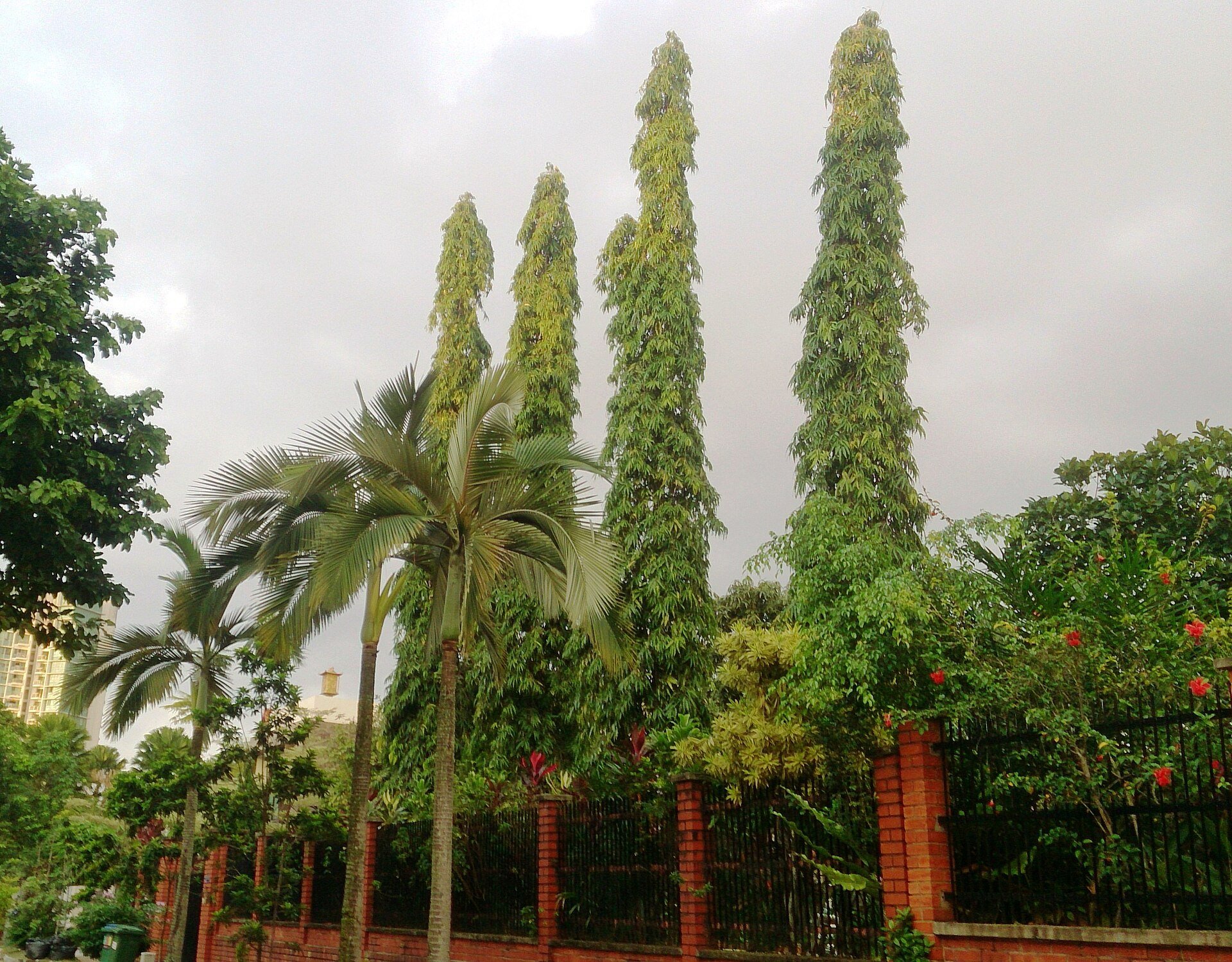
The Ashoka, also called the Mast tree, is the tall, narrow, evergreen tree with long wavy leaves that lines roads, parks and campuses across north India. In Rajasthan it brings year-round green to gardens and boundaries, and its fruits and leaves feed birds and butterflies.
Photo: "Indian Mast Tree" by Mokkie, CC BY-SA 3.0 (https://creativecommons.org/licenses/by-sa/3.0), via Wikimedia Commons
Quick facts
| Scientific name | Monoon longifolium (syn. Polyalthia longifolia) |
| Family | Annonaceae (custard-apple / sitaphal family) |
| Hindi name | अशोक (Ashok); आशापाला (Ashapala) in Rajasthan forest records |
| Height | 8–12 m in gardens; up to about 20 m in the wild |
| Lifespan | Long-lived evergreen; no reliable figure is published |
| Growth rate | Moderate |
| Water need | Moderate; regular watering in the first years |
| Best planting months in Jaipur | July–August (best); February–March (with irrigation) |
| Jaipur suitability | Good as a landscape and boundary tree; marginal as a low-water restoration tree |
| Conservation status | Least Concern (IUCN) |
Which "Ashoka" is this?
When most people in north India say "Ashoka tree", this is the tree they picture. Flowers of India notes that the name Ashok "has stuck in north India", although the "real" Ashok is Sita Ashok. This article is about the tall roadside Mast tree, Monoon longifolium, which most Indian books and nurseries still call Polyalthia longifolia.
Nurseries in north India almost always sell the narrow, weeping, column-shaped form (often labelled var. pendula). The wild form grows into a larger, spreading shade tree. If you want shade, ask the nursery which form it is supplying.
Why plant it in Jaipur?
It is cultivated across India and is recorded in Rajasthan forest working plans as ashapala and ashok. It stays green all year, makes a neat living screen for avenues and boundaries, and feeds birds and butterflies.
Be realistic about its limits. It is native to south India and Sri Lanka, not Rajasthan. It needs more water than desert natives such as Khejri, and young plants are sensitive to frost. As practical advice, plant it alongside native Rajasthan trees such as Khejri, Neem and Peepal, not instead of them.
How to plant it
When: July–August (monsoon) is best, as rain helps the roots settle before the dry season. February–March is second-best if you can water regularly. October planting can work, but the young plant then needs regular watering, mulch, a frost cover and a tree guard through its first winter and summer. Avoid late April to June (heat) and December–January (frost).
Practical steps:
- Choose a nursery sapling, 1–2 years old and 1.0–1.5 m tall, hardened in full sun. Seed germinates poorly (about 20%) and stays viable for only about three months.
- Dig a pit about 60 × 60 × 60 cm. Refill it with the dug soil mixed with 5–10 kg of well-rotted farmyard manure. Add neem cake where termites are common.
- Plant at the same depth as in the nursery bag, with the root collar at ground level. Avoid waterlogged or hard-pan spots.
- Spacing: 3–5 m apart in a row for the column form (for a screen or avenue); 6–8 m apart for the spreading form.
- Protect it with a tree guard against goats and cattle, and build a basin to hold water.
Care in the first 3 years
In year 1, give about 15 litres per watering in the cooler months and 20–25 litres in summer.
Monsoon (Jul–Sep): In year 1, water only if there is no rain for 7–10 days, and weed monthly. In years 2 and 3, add 5–10 kg of manure.
After the monsoon (Oct–Nov): Spread 5–8 cm of mulch (dry grass or leaf litter). Water weekly in year 1, then every 10–14 days in year 2.
Winter (Dec–Feb): In the first two winters, cover the sapling with jute or a dry-grass cap on cold nights (forecast 4 °C or lower) and remove it by day. Water every 10–12 days, in the late morning.
Spring (Mar–Apr): Water every 5–7 days in year 1. Trim away frost-scorched tips once new growth starts.
Summer (May–Jun): The most critical season. Water every 3–4 days in year 1, every 5–7 days in year 2 and every 10–14 days in year 3, early morning or evening. If leaves scorch, shade the west side with a net. Plan life-saving watering in May–June for the first 3–4 years.
Pruning and pests: Keep one straight leader. The column form needs no pruning. Tailed Jay and Common Jay caterpillars eat young leaves; they are native butterflies, so do not spray. Check for termites in sandy soil.
Benefits
For wildlife
- The fruits are eaten by birds and fruit bats and are "a favourite food for Koels". It is listed as a bird-attracting plant.
- It is a larval food plant of the Tailed Jay butterfly (Graphium agamemnon), and Common Jay (Graphium doson) caterpillars have also been photographed on it.
For gardens and towns
- Evergreen, so it stays green all year. The column form casts only a narrow strip of shade; the spreading form gives fuller shade.
- It is commonly planted as an avenue tree, noise screen and living boundary.
Wood
- Its straight, light, flexible trunks were once used for ship masts, which is how it got the name "Mast tree". Today the soft, even-grained wood is used for pencils, boxes and matchsticks.
Cultural significance
In north India this tree has taken over the name "Ashoka" in everyday speech, and its leaves are used in festival and wedding decorations, for example as door torans in Gujarat. It became popular as an avenue and garden tree in the British period. It has no valid Sanskrit name.
Not to be confused with the true Ashoka (Saraca asoca)
The Ashoka of old texts, also called Sita Ashok, is a different tree: Saraca asoca, of the pea family (Fabaceae). It is small to medium (about 6–10 m) with a spreading crown, compound leaves and clusters of orange-to-crimson flowers. It grows in moist forests and needs high rainfall (about 1,500–4,000 mm), partial shade and moist soil, so it suits Jaipur poorly. Over-harvesting of its bark is a key threat, and it is listed as Near Threatened on the current IUCN Red List.
The Mast tree does not share the traditional uses of Saraca asoca. Its bark is a known, chemically different adulterant of genuine Ashoka bark in the herbal trade, so do not use it as "Ashoka" medicine.
Cautions and safety
- Toxicity: Not documented for people, pets or livestock. No poisoning has been recorded, but the fruit is not a recognised human food. Birds and fruit bats eat the fruit; there is no data for dogs, cats or livestock.
- Water: It needs more water than desert natives, especially in years 1–3. This matters in water-stressed Jaipur.
- Air pollution: A Delhi study rated it the most pollution-sensitive of seven species tested, so we do not present it as a pollution-fighting tree.
- Invasiveness: It is not recorded as invasive in India.
Plant an Ashoka (Mast tree) in someone's name with GreenEye: Gift a Tree
Planting calendar
- Northwest arid · Monsoon · Jul, Aug
- Northwest arid · Post-monsoon · Sep, Oct
- Northwest arid · Spring · Feb, Mar
Planting methods
SaplingPrimary method
Seed
Air layering
Benefits
- Shade and cooling: Evergreen and green all year. The common column form gives only a narrow strip of shade; the spreading form gives fuller shade.
- Biodiversity: Its fruits are eaten by birds and fruit bats and are a favourite food of koels; it is listed as a bird-attracting plant.
- Biodiversity: A larval food plant of the Tailed Jay butterfly; Common Jay caterpillars have also been recorded on it.
- Timber: Straight, light trunks were once used for ship masts; the soft, even-grained wood is used for pencils, boxes and matchsticks.
- Cultural: Its leaves are used in festival and wedding decorations, such as door torans in Gujarat.
- Ornamental: A formal, striking column shape used for avenues, screens, boundaries and focal points.
- Other: Commonly planted as a living screen and noise screen along boundaries.
Frequently asked questions
Is this the same as the holy Ashoka tree of the Ramayana?
No. This is the tall "Ashoka" (Mast tree) seen along roads. The Ashoka of the scriptures is a different, red-flowered tree called Sita Ashok (Saraca asoca).
Will it give shade?
The common column-shaped Ashoka gives only narrow shade. It is valued for its evergreen beauty, and as a home and food source for birds and butterflies.
How tall will it grow?
Usually 8–12 m in gardens, and taller in the wild. It grows at a moderate pace.
Will it survive Jaipur's summer and winter?
Yes, with care. We water it regularly for the first few years, mulch it, and cover it on frosty nights in its first two winters.
Does it flower or fruit?
Yes. It has small pale-green star-shaped flowers in March–April and clusters of small fruits that birds such as koels love.
Sources
- Kew, World Checklist of Vascular Plants (WCVP) via GBIF: Monoon longifolium
- Plants of the World Online (Kew)
- National Parks Board Singapore, Flora & Fauna Web: Monoon longifolium
- Flowers of India: Ashok (Monoon longifolium)
- Flowers of India: Sita Ashok (Saraca asoca)
- eFlora of India: Monoon longifolium
- Wikipedia: Monoon longifolium
- Useful Tropical Plants: Monoon longifolium
- Top Tropicals: Polyalthia longifolia (general care notes)
- Indian Journal of Agricultural Sciences: Air Pollution Tolerance Index of tree species in Delhi (ICAR-IARI)
- TNAU Agritech Portal: Forestry nursery, Polyalthia longifolia
- Life cycle of the Tailed Jay butterfly on Polyalthia longifolia (ResearchGate)
- Wikimedia Commons: Common Jay caterpillar on Polyalthia longifolia
- Indian Journal of Natural Products and Resources: differentiating Saraca asoca bark from its adulterant Polyalthia longifolia
- India Tree Pix discussion: leaves used as toran in Gujarat
- IUCN Red List category via GBIF: Polyalthia longifolia (LC)
- Useful Tropical Plants: Saraca asoca
- RCFC Southern (NMPB): Saraca asoca
- IUCN Red List category via GBIF: Saraca asoca
This article was prepared with AI assistance. Please verify important details with the sources listed.
Plant a tree you can track
Plant a tree on GreenEye land and track it as it grows.
Share this article