Arjun Tree (Terminalia arjuna): How to Plant and Care for It in Jaipur
Terminalia arjuna
Arjun is a large native shade tree of India's riverbanks, valued in Ayurveda. It can grow well in Jaipur if planted in a moist, low-lying spot and watered for its first few years. Here is when and how to plant it, and what to watch for.
Bot User
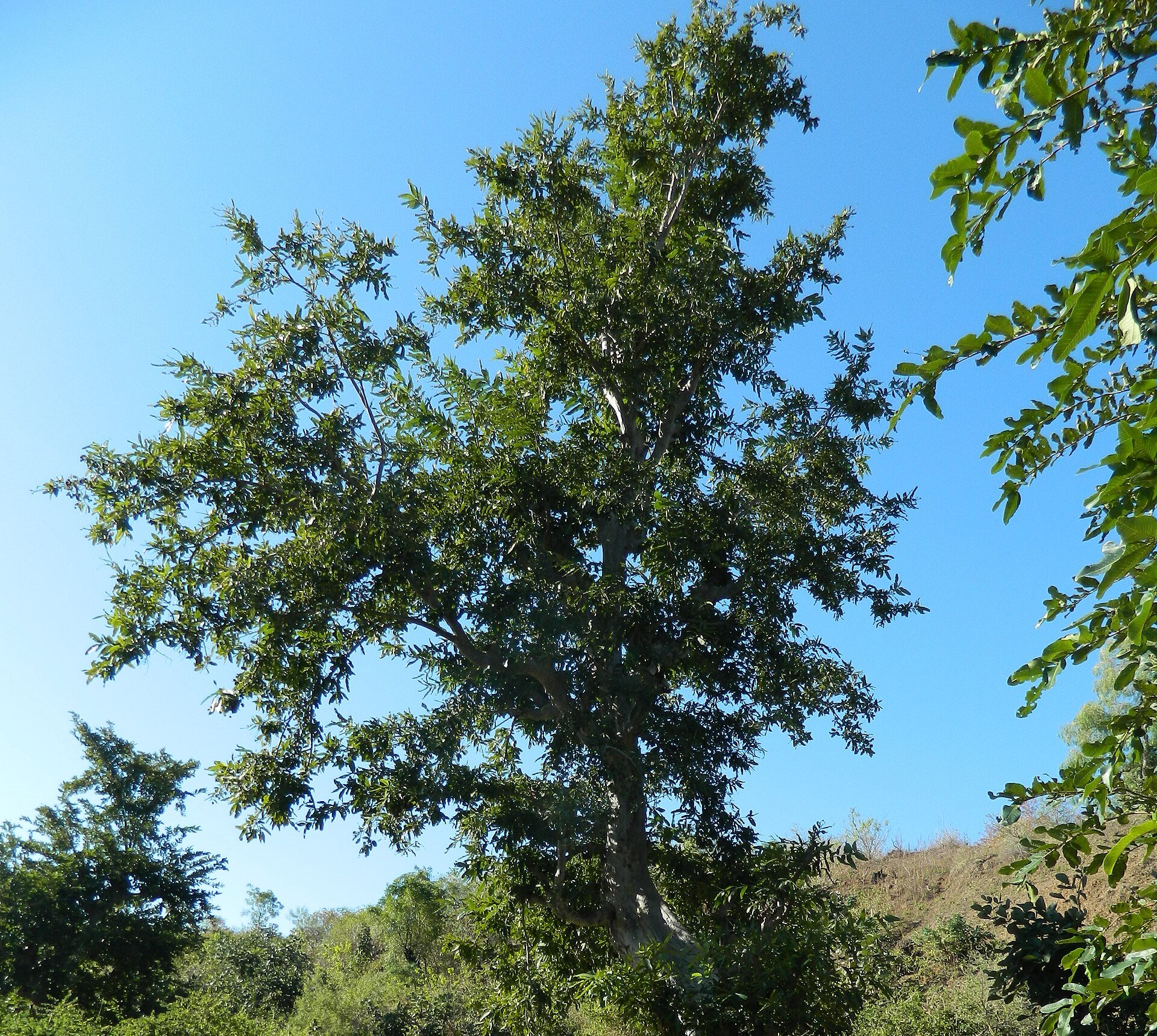
The Arjun is a large native shade tree with smooth, pale bark and a broad, spreading crown. In nature it grows along rivers and streams, where its roots help hold the soil together. In Jaipur it needs a well-chosen spot and regular water while young, but with that care it grows into a lasting landmark of shade.
Photo: "अर्जुनाचे झाड Arjun tree (Terminalia arjuna)" by MGB CEE, CC BY-SA 4.0 (https://creativecommons.org/licenses/by-sa/4.0), via Wikimedia Commons (cropped)
Quick facts
| Scientific name | Terminalia arjuna |
| Family | Combretaceae |
| Hindi name | अर्जुन (Arjun); also Kahua or Koha in parts of north India |
| Height | Up to about 25 m; up to 30 m in forests. Expect less in Jaipur's drier conditions |
| Lifespan | Long-lived; no reliable published figure |
| Growth rate | Moderate: slow at first, then about 2 to 3 m in 3 years |
| Water need | Regular watering for the first 2 to 3 years; moderate once established |
| Best planting months in Jaipur | July and August (monsoon) |
| Jaipur suitability | Good, with irrigation in the early years and a moist, low-lying site |
| Conservation status | Least Concern (IUCN) |
Why plant an Arjun in Jaipur?
Arjun is naturally a riverbank tree. It usually grows where rainfall is 750 to 1,900 mm a year, more than Jaipur receives, so it is not a tree to plant on a dry, rocky slope and forget.
Still, it is widely grown in semi-arid north-west India. Citizen-science records show Arjun trees in Jaipur, including Bapu Nagar and Jagatpura, and in Kota and other districts of Rajasthan.
The key is the site. Arjun does best in low-lying spots that hold moisture: near ponds, johads, rainwater-harvesting pits or drains. There it gives deep shade, protects banks from erosion and can help improve alkaline land.
How to plant an Arjun
When to plant
- Best: July to August. Monsoon rain helps the sapling settle and gives it a full season before summer.
- Second choice: February to March, only if you can water it reliably through April to June. This avoids the sapling's first winter frost.
- Avoid October to January (frost risk) and April to June (heat).
Sapling, pit and spacing
- Use a nursery sapling raised from seed, about 1 to 1.5 years old and 60 to 120 cm tall, with one sturdy stem.
- Dig a pit about 60 × 60 × 60 cm. Refill with topsoil, 5 to 10 kg of well-rotted farmyard manure and some neem cake against termites.
- Plant at the same depth as in the nursery bag. Make a basin 1 to 1.2 m wide, with no standing water at the stem.
- Space trees 8 to 10 m apart, at least 8 m from buildings and walls.
- Fit a tree guard, because cattle and goats eat the leaves.
First-year watering in Jaipur
Practical guidelines; adjust to rain and soil moisture.
| Season | How often | Amount |
|---|---|---|
| July to September | Only if there is no rain for 7 to 10 days | 15 to 20 L |
| October to February | Every 7 to 10 days | About 20 L |
| March to April | Every 5 to 7 days | 20 to 25 L |
| May to June | Every 3 to 4 days, early morning | 25 to 30 L |
Drip irrigation works well. Deep waterings in May and June are worth continuing for about the first five years.
Care in the first three years
Monsoon. Weed the basin regularly for the first two years and widen it as the tree grows.
October to November. Lay 7 to 10 cm of mulch. Water every 7 to 10 days in year 1, every 10 to 14 days in year 2, and every 2 to 3 weeks in year 3.
Winter. Frost can leave young stems forked and bushy. For the first two winters, cover the sapling with jute or thatch on cold nights.
Spring. New leaves appear. If frost has forked the stem, prune back to one strong main stem.
Summer. The critical season. Water every 3 to 4 days in year 1, every 5 to 7 days in year 2, and deeply every 7 to 10 days in year 3.
Pests. Powdery mildew, leaf-rolling weevils, caterpillars and white wax scale can appear. They are usually minor; treat only severe damage.
Benefits of the Arjun tree
Shade and cooling
An excellent shade tree, planted along avenues, roadsides and in parks for its shade and drooping crown.
Soil and water
Its roots reduce erosion along stream banks, channels and tank bunds. Arjun is used to reclaim saline and alkaline soils and ravines, and a dense Arjun plantation on sodic soil in India improved the soil.
Wildlife and pollinators
Arjun is a keystone tree of riverside forests in peninsular India. Its small, honey-scented flowers in April and May attract insects, and its leaves feed the tasar silkworm.
Fodder and other uses
Farmers lop the leaves for fodder. The heartwood is very hard and the bark yields tannin. GreenEye's gift trees are never cut or stripped.
Traditional medicine
Arjun bark appears in classical Ayurvedic texts such as the Charaka Samhita. It is traditionally used in Ayurveda as a heart tonic and for wounds, fractures and urinary complaints. This is traditional use only, not medical advice; please consult a qualified doctor.
Cultural significance
The tree shares its name with Arjuna, the Pandava hero of the Mahabharata. Its leaves and flowers have sacred value in India, and astrologers link the tree with the nakshatra Swati. In parts of India, Arjun leaves are counted among the 21 leaves offered to Lord Ganesha during Ganesh Chaturthi puja.
Cautions and safety
- Space. Arjun grows large, often with a buttressed trunk. Keep it at least 8 m from buildings, walls, septic tanks and pipes.
- Shallow roots. Its roots are shallow and spread outwards, so they can lift paving nearby.
- Water. It struggles on dry, rocky, upland sites without irrigation.
- Frost. Protect young plants for their first two winters.
- Bark stripping. Public trees are sometimes illegally stripped for medicine. This injures the tree, so protect the trunk.
- Toxicity. Arjun is not documented as toxic, but there is no reliable safety profile for its raw parts, so do not eat any part. The leaves are a traditional livestock fodder; there is no reliable information for cats and dogs.
Arjun is native to India and is not reported as invasive here.
Plant an Arjun in someone's name with GreenEye: Gift a Tree
Planting calendar
- Northwest arid · Monsoon · Jul, Aug
- Northwest arid · Spring · Feb, Mar
Planting methods
SaplingPrimary method
Seed
Benefits
- Shade and cooling: An excellent shade tree, planted along avenues, roadsides and in parks.
- Soil health: Used in agroforestry and social forestry to reclaim saline and alkaline soils and ravines; a dense Arjun plantation on sodic soil in India improved the soil.
- Water conservation: Its root mass reduces erosion along stream banks, irrigation channels and tank bunds.
- Biodiversity: A keystone tree of riverside forests in peninsular India; its leaves feed the tasar silkworm.
- Pollinators: Small, strongly honey-scented cream-white flowers in April and May attract insects.
- Medicinal: The bark is traditionally used in Ayurveda as a heart tonic and for wounds, fractures and urinary complaints. Traditional use only, not medical advice.
- Fodder: Leaves are lopped as livestock fodder.
- Timber: The heartwood is very hard, strong and heavy. GreenEye gift trees are never felled.
- Ornamental: Smooth, pale, flaking bark and a drooping crown make it a handsome roadside tree.
- Cultural: Its leaves and flowers have sacred value in India, and astrologers link it with the nakshatra Swati.
- Other: The bark is a source of tannin.
Frequently asked questions
Can an Arjun tree really grow in dry Jaipur?
Yes, with care. It naturally grows near water, so it should be planted in a moist spot and watered regularly for its first few years.
How big will it get?
Arjun can grow to around 20 to 25 m with a wide crown, so each tree needs plenty of space.
Will GreenEye harvest its bark for medicine?
No. Gift trees are never cut or stripped. They are planted for shade, soil and nature.
When will it flower?
Arjun usually starts flowering and fruiting about 6 to 7 years after planting, with small honey-scented flowers in April and May.
Is Arjun good for the environment?
Yes. It gives deep shade, its roots hold soil, it helps improve degraded and alkaline land, and it supports insects and birds.
Sources
- Kew, World Checklist of Vascular Plants (via GBIF): Terminalia arjuna
- Orwa C. et al. (2009), ICRAF Agroforestree Database 4.0: Terminalia arjuna
- Flowers of India: Arjun Tree
- IUCN Red List category (LC) via GBIF
- A comprehensive review of the medicinal properties of Terminalia arjuna (PMC)
- Jui L.A. et al. (2026), Terminalia arjuna under severe water stress, Plants 15(6):888
- Biomass production and soil amelioration in a high density Terminalia arjuna plantation on sodic soils, Biomass and Bioenergy (1998)
- iNaturalist observations of Terminalia arjuna in Rajasthan
- Status and ecological significance of Terminalia arjuna in the Moyar River valley, Journal of Wildlife Science
- Ugaoo: 21 Patri leaves for Ganesh Pooja (popular source)
This article was prepared with AI assistance. Please verify important details with the sources listed.
Plant a tree you can track
GreenEye plants trees like this one on our land. Track yours as it grows.
Share this article