Sagwan (Teak) Tree (Tectona grandis): Where It Grows in India and How to Plant It
Tectona grandis
Sagwan or teak (सागवान, सागौन) is Tectona grandis, India's best-known timber tree, native to the forests of the peninsula and central India and reaching into southern Rajasthan. How to plant it and when, how to recognise it, how fast it grows, care for the first three years, and what to watch out for.
Overview
Teak, called sagwan or sagaun (सागवान, सागौन) in Hindi, is Tectona grandis, a tall deciduous timber tree that grows wild in the forests of peninsular and central India and reaches north into the hills of southern Rajasthan. It is the tree behind India's most famous furniture wood, and it is planted on farms, along roads and in school grounds across the country.
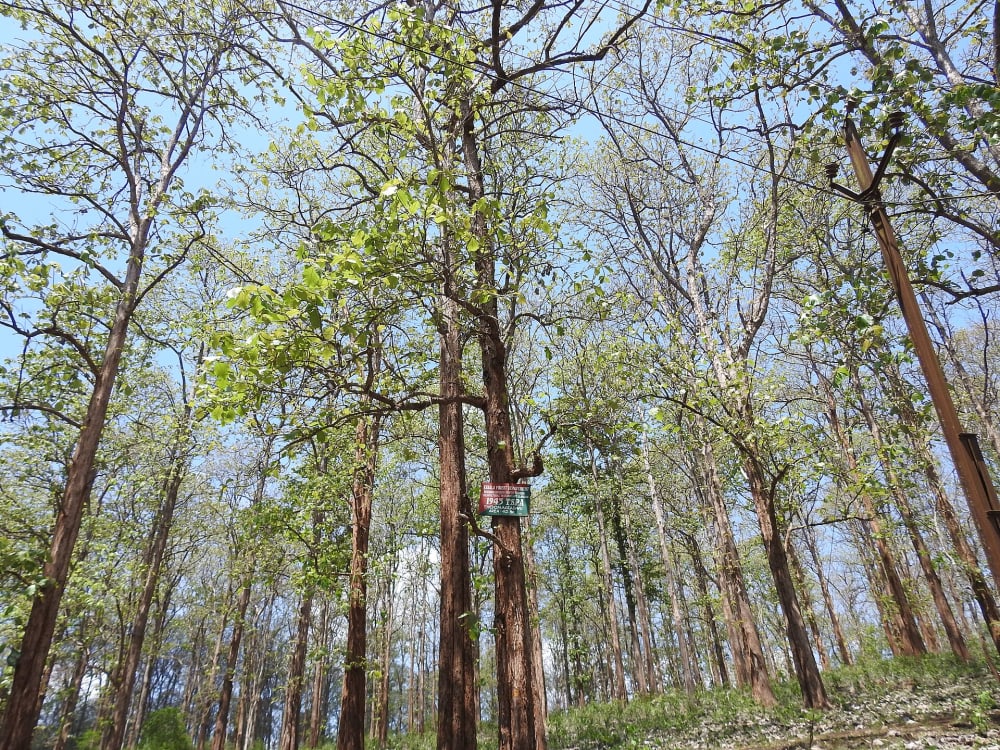
In the monsoon a teak tree is easy to spot: huge leaves, often as long as a school ruler, and frothy clusters of tiny white flowers at the top of the crown. In the dry season it stands bare. It is a fast starter, a long-lived tree and a poor choice for small spaces.
Photo: "Teak plantation in Kerala" by Anand.osuri, CC BY-SA 4.0, via Wikimedia Commons
Quick facts
| Scientific name | Tectona grandis L.f. (Kew WCVP, via GBIF) |
| Family | Lamiaceae (mint family); older books place it in Verbenaceae |
| Hindi name | सागवान (Sagwan), सागौन (Sagaun), also Sagun |
| English name | Teak; also Indian oak (ICRAF) |
| Other names | Saag (Marathi, Gujarati), Segun (Bengali), Tekku (Tamil), Teku (Telugu), Saguvani (Kannada), Thekku (Malayalam), Shaak (Sanskrit) |
| Mature height | Over 30 m in good conditions (ICRAF); much smaller on dry, shallow soil |
| Growth rate | Fast when young; ICRAF says growth slows after roughly 15–20 years |
| Leaves | Very large, in opposite pairs, roughly 15–60 cm long (KFRI) |
| Flowers | Tiny, white to cream, in big clusters at the branch tips, mainly in the rainy season |
| Water need | Moderate; does not tolerate waterlogging (ICRAF) |
| Planting season | With the monsoon in most of India; months are a guide, see the Planting calendar |
| Grows well in | Central India, the Deccan, the Western Ghats and their foothills, and the hills of southern Rajasthan |
| Conservation status | Endangered (IUCN Red List global assessment, 2022) |
Sources: Kew World Checklist of Vascular Plants via GBIF: Tectona grandis L.f. (accepted; native distribution Assam, Bangladesh, Cambodia, India, Laos, Myanmar, Thailand, Vietnam; introduced in Sri Lanka, Java, Andaman Is. and others); GBIF species API: IUCN Red List category for Tectona grandis (ENDANGERED, iucnTaxonID 62019830); IUCN Red List: Gua B., Pedersen A. & Barstow M. (2022). Tectona grandis. e.T62019830A62019832 (Endangered; citation as given by Wikipedia, page not readable by script); eFlora of India: Tectona grandis (vernacular names)
This article was prepared with AI assistance and checked by the GreenEye team against the sources shown in each section.
Plant a tree you can track
Plant a tree on GreenEye land and track it as it grows.
Share this article