Coconut (Nariyal) Tree (Cocos nucifera): Where It Grows in India and How to Plant It
Cocos nucifera
Nariyal is the coconut, Cocos nucifera of the palm family. How to plant a coconut tree in India: the best season, pit and seedling, care for three years, years to fruit, how to recognise it, and why it will not do well in Rajasthan.
Overview
Coconut, called nariyal (नारियल) in Hindi and Cocos nucifera by botanists, is a tall palm with a single woody stem that grows best along India's warm, humid coasts and islands. It is the only species in its genus (Flowers of India), and an ICAR-CPCRI bulletin (2018) notes that it is called Kalpavriksha, the tree of heaven, because every part of it is useful. The same bulletin says Kerala, Tamil Nadu, Karnataka and Andhra Pradesh together hold more than 90 per cent of India's coconut area and production.
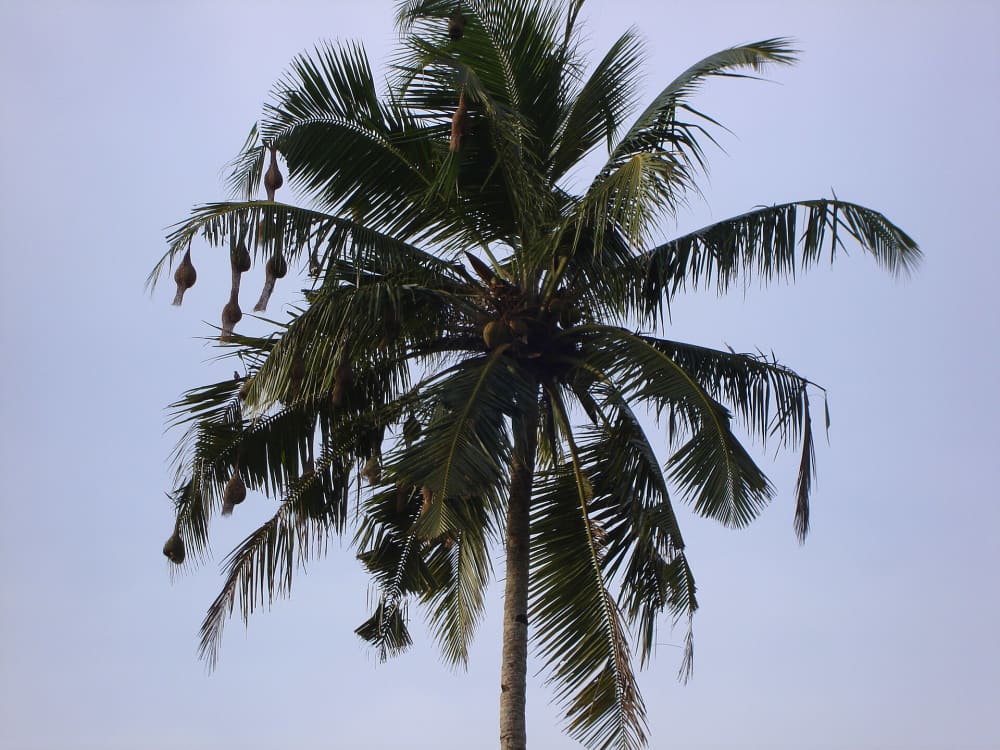
Photo: "Goa, India 31 Coconut tree with bird's nests" by Fredericknoronha, CC BY-SA 4.0, via Wikimedia Commons
It is a palm, but it behaves like a tree: one trunk, one crown and a working life of decades. It needs steady warmth, humid air, full sun and a lot of water, so, put plainly, coconut will not do well in Rajasthan or in other dry, cold-winter parts of north-west India.
Quick facts
| Scientific name | Cocos nucifera L. (accepted name, Kew WCVP via GBIF) |
| Family | Arecaceae (palm family) |
| Hindi name | नारियल (Nariyal); also written narel or naryal (Flora of Pakistan) |
| English names | Coconut, coconut palm, coconut tree |
| Other names | Naral (नारळ) and Shriphal (Marathi), Narlu (Konkani), Tennai (தென்னை, Tamil), Thengu (Malayalam), Kobbari (Telugu) (Flowers of India); Narikel (Bengali, ICRAF); Kalpavriksha |
| Type of plant | A palm with one unbranched woody stem and no side branches |
| Mature height | Roughly 15–18 m for tall types and 5–7 m for dwarf types (ICAR-CPCRI) |
| First nuts | Roughly 5–7 years after planting for tall types, 3–4 years for dwarfs (ICAR-CPCRI) |
| Flowering | Through the whole year (Flora of Pakistan) |
| Climate | Mean temperature roughly 27 °C (±5 °C) and humidity above 60 per cent; grows well up to roughly 600 m (ICAR-CPCRI) |
| Water need | High: ICAR-CPCRI gives roughly 2,000 mm of well-spread rain a year as best, otherwise irrigation |
| Planting season | With the monsoon, mostly May–July; October–November only on the east coast, where the main rains come with the north-east monsoon; months are a guide |
| Grows well in | The west and east coasts, the islands and the humid south |
| Not suitable | Rajasthan, the north-west dry zone, the northern plains and the Himalaya (our assessment) |
| Conservation status | Not yet assessed on the IUCN Red List (GBIF record checked October 2026) |
Sources: Kew World Checklist of Vascular Plants via GBIF: Cocos nucifera L. (accepted; native C. Malesia to SW. Pacific; India, Andaman, Nicobar, Laccadive Is. and Assam recorded as introduced); GBIF species API: IUCN Red List category for Cocos nucifera (NOT_EVALUATED); GBIF species API: vernacular names for Cocos nucifera (Hindi नारियल, khopar); Subramanian P. et al. (2018). Coconut. Technical Bulletin No. 133, ICAR-Central Plantation Crops Research Institute (CPCRI), Kasaragod; Flowers of India: Coconut (Cocos nucifera), names and description; Orwa et al. (2009). Agroforestree Database 4.0 (ICRAF / World Agroforestry): Cocos nucifera; Flora of Pakistan: Cocos nucifera (vernacular Narel, Naryal; flowering through the year)
This article was prepared with AI assistance and checked by the GreenEye team against the sources shown in each section.
Plant a tree you can track
Plant a tree on GreenEye land and track it as it grows.
Share this article