Gular Tree (Ficus racemosa): Where It Grows in India and How to Plant It
Ficus racemosa
Gular (गूलर), the cluster fig, is Ficus racemosa, a native fig tree of India's rivers and ponds. What a gular tree looks like, why nobody sees its flower, where it grows in India, how to plant it and care for it for three years, and what to watch out for.
Overview
Gular (गूलर), the cluster fig in English, is Ficus racemosa, a large native fig tree that grows wild beside rivers, streams and village ponds across most of India and bears its round figs in bunches on the trunk.
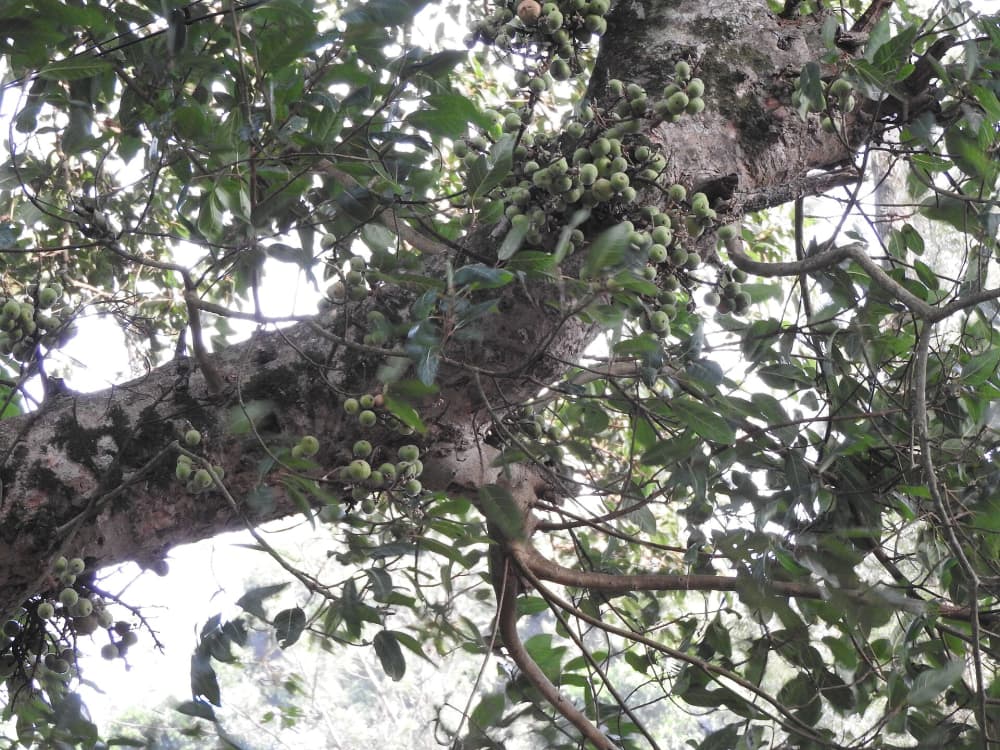
It is a cousin of the bargad (banyan) and the peepal, but it has no hanging aerial roots, and its figs grow straight out of the trunk and old branches rather than among the leaves. The famous puzzle of the "gular ka phool" has a simple answer: the tree does flower, but its tiny flowers are hidden inside each fig.
Photo: "Ficus racemosa-1-sengalathupadi-yercaud-salem-India" by Yercaud-elango, CC BY-SA 4.0, via Wikimedia Commons
Quick facts
| Scientific name | Ficus racemosa L.; older books use the synonym Ficus glomerata (Kew WCVP, read via GBIF) |
| Family | Moraceae (fig and mulberry family) |
| Hindi name | गूलर (Gular, also written Goolar); गुल्लर (Gullar) in Rajasthan |
| English name | Cluster fig; also country fig |
| Also called | Udumbara / Audumbara (Sanskrit); Umbar (Marathi); Umbaro (Gujarati); Atti (Tamil, Kannada, Malayalam); Dumur (Bengali); Dumar, डूमर (Hindi, eFlora of India) |
| Mature height | Roughly 15–20 m as a rough guide; Flora of China gives 25–30 m for big trees |
| Growth rate | Fast as a seedling (a Kerala nursery trial); no field figure found |
| Leaves | Sheds leaves in January away from water, stays green near water (Flowers of India) |
| Figs | 2–2.5 cm across, in clusters on the trunk, reddish orange when ripe (Flora of China) |
| Water need | Moderate to high: it likes moist ground near water |
| Planting season | With the monsoon, mostly July–August; months are a guide, see Planting calendar |
| Grows well in | Most of India on moist land; in the dry north-west only near water or with assured watering |
| Conservation status | Least Concern (IUCN Red List global assessment, 2019) |
Sources: Kew World Checklist of Vascular Plants (via GBIF): Ficus racemosa L., accepted name; native Pakistan, India (incl. West and East Himalaya, Assam, Andaman Is.), Nepal, Bangladesh, Sri Lanka to Indochina, south China, Malesia, New Guinea and northern Australia; Kew World Checklist of Vascular Plants (via GBIF): synonyms of Ficus racemosa (incl. Ficus glomerata Roxb.); GBIF species API: IUCN Red List category for Ficus racemosa (Least Concern, iucnTaxonID 145362959; assessment e.T145362959A145371147, 2019); GBIF species API: vernacular names of Ficus racemosa (cluster fig, country fig); Kew Plants of the World Online: Ficus racemosa L. (native range Pakistan to N. Australia); Flowers of India: Goolar (Ficus racemosa); eFlora of India: Ficus racemosa (names, habitat, two fig crops); Plants of Rajasthan (A. Jangir): Ficus racemosa L. (Rajasthan districts, fig colour, phenology); Flora of China Vol. 5 (eFloras): Ficus racemosa (description, habitat 100-1,700 m)
This article was prepared with AI assistance and checked by the GreenEye team against the sources shown in each section.
Plant a tree you can track
Plant a tree on GreenEye land and track it as it grows.
Share this article